


Bidar Tourist Places
Discover the incredible past of one of southern India’s most important historical cities as you explore the places to visit in Bidar. Karnataka’s Bidar dates back to the Mauryan era and was an important centre of power under many subsequent dynasties. The city gained prominence when it became the capital of the Bahmani Sultanate in the fourteenth century. It continued to be central to Deccan politics under the Barid Shaahis, the Mughals, and later under the Nizams of Hyderabad.Such a rich history shows in the modern Bidar, where you can see numerous heritage structures constructed by the Bahmanis and Barid Shaahis. The most popular among all attractions is the Bidar Fort, where you can see royal palaces, fortifications, gateways, and a mosque. Some of the popular historical places to visit in Bidar include the Bahmani Tombs, Chaubara Clock Tower, and Barid Shaahi Tombs. Also, you cannot miss the iconic Solah Khamba Mosque and the Madrasa of Mahmud Gawan during your Bidar tour.
Plan your Bidar trip now and explore one of Karnataka’s most stunning cities with your friends and family.
Here are some of the best Bidar places to visit:
1. Bidar Fort
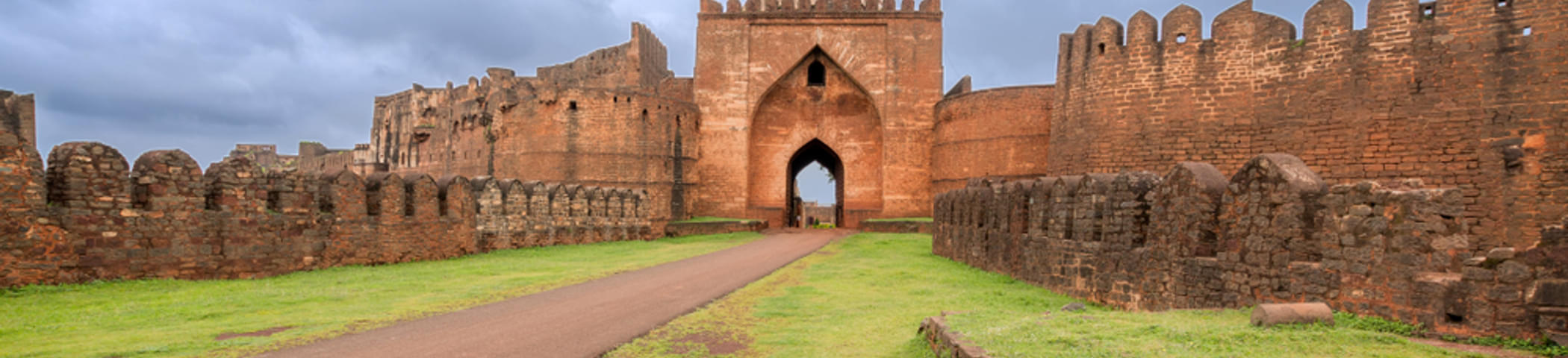
Located in the eastern part of Bidar in what is known as the Old City Fort Area, the fort is a must-visit for history lovers. The structure dates to the fourteenth century and was constructed by the Bahmani ruler Ahmad Shah Wali. It was later renovated by Sultan Ahmad Shah I when he shifted the kingdom’s capital from Gulbarga to Bidar.The fort was part of the planned medieval city of Bidar and had palaces, mosques, and other structures constructed out of rock. The entrance has a massive dome, followed by a zigzag passage protected by three stunning gateways. Admire this magnificent example of Islamic and Persian architecture and explore the ruins with a knowledgeable guide for an enhanced experience. While the original structure was built by the Bahamanis, you can see later additions and influences of the Mughals and Nizams as well.
Highlights
- Go on a guided tour of one of India’s most formidable forts- the fourteenth-century mighty Bidar Fort.
- Explore the ruins of stunning structures like Rangeen Mahal, Tarkash Mahal, and Gagan Mahal within the fort.
- Admire the Islamic and Persian architectural features of major structures like Diwan-i-Aam, Diwan-i-Khas, and Takht Mahal here.
- See massive octagonal-shaped bastions lined with metal-shielded cannons on the fort walls during your tour.
How to Reach
- By Car - Bidar Fort is about 2 kilometres from the city centre, a 7-minute ride via Fort Road.
-
By Foot - To reach Bidar Fort on foot, you can walk via Qudwai Road, and reach in around 30 minutes.
2. Gurudwara Nanak Jhira Sahib
Soak in the calming spiritual vibe of one of South India’s rare Sikh pilgrimage sites as you visit the Gurudwara Nanak Jhira Sahib. It is believed that Guru Nanak had visited Bidar when the region was facing a famine. At the request of the locals, he performed a miracle and brought a water spring from a rock here. This spring is now said to be the source of the Amrit Kund or lake found on the gurudwara premises.
The faithful believe that this water is magical and cures several ailments. When you visit the gurudwara, you can explore the museum and learn about the incredible history and contributions of the Sikh community over centuries. Pay your respects to the holy Guru Granth Sahib and relish the Langar that is served to every visitor here.
Highlights
The faithful believe that this water is magical and cures several ailments. When you visit the gurudwara, you can explore the museum and learn about the incredible history and contributions of the Sikh community over centuries. Pay your respects to the holy Guru Granth Sahib and relish the Langar that is served to every visitor here.
Highlights
- Explore the serene beauty of one of South India’s rare and most famous gurudwaras at the Gurudwara Nanak Jhira Sahib.
- Pay your respects to the holy Guru Granth Sahib and enjoy a delicious Langar while you visit the gurudwara.
- Listen to the fascinating legend of the Amrit Kund that led to the construction of the gurudwara around it.
- Take a tour of the Sikh Museum and learn about the incredible contributions of the Sikh community to the history of India.
How to Reach
-
By Car - Gurudwara Nanak Jhira Sahib is about 3 kilometres from the city centre, an 11-minute ride via Naubad Road.
3. Shri Kshetra Jharni Narasimha Temple
Go on a spiritual adventure as you visit the cave temple of Shri Kshetra Jharni Narasimha Temple near Bidar city. This cave lies under the Manichoola Hills and is filled with waist-deep water, which you need to cross to reach the ancient Lord Narasimha idol. It is believed that the idol self-manifested in this remote cave on the outskirts of Bidar, which makes the temple incredibly popular. The faithful believe that the deity, the half-human half-lion incarnation of Lord Vishnu, fulfils all their wishes when worshipped here.
The cave is around 300 metres long and has been filled with water from the perennial stream for centuries. As per the legend of Jalasura who was slain by Lord Narasimha at this site, you can also see a Shivalingam at the cave-end. An incredible blend of spirituality and adventure, this temple is a must-visit for you and your loved ones.
The cave is around 300 metres long and has been filled with water from the perennial stream for centuries. As per the legend of Jalasura who was slain by Lord Narasimha at this site, you can also see a Shivalingam at the cave-end. An incredible blend of spirituality and adventure, this temple is a must-visit for you and your loved ones.
Highlights
- Discover the thrill of exploring a cave temple beneath the hills of Manichoola near Bidar at the Shri Kshetra Jharni Narasimha Temple.
- Navigate through waist-deep water for 300 metres to reach the iconic self-manifested idol of Lord Narasimha here.
- Pay your respects to the ancient idol of Lord Narasimha, who is believed to fulfil all your wishes in this temple.
- Spot the ancient Shivalingam here and learn the fascinating legend of Jalasura who was slain by Lord Narasimha at this spot.
How to Reach
- By Car - Shri Kshetra Jharni Narasimha Temple is about 4.4 kilometres from the city centre, an 11-minute ride via NH 161B.
4. Shri Papnasha Mahadeva Swami Temple
Situated in the heart of Bidar is the iconic Shri Papnasha Mahadeva Swami Temple, which dates back to the Ramayana era. It is believed that Lord Rama, after his victory against Ravana, installed a Shivalingam right at this place before heading back to Ayodhya. While the Shivalingam has survived, the current temple was constructed on the ruins of an ancient structure. The deity here is believed to be incredibly powerful, which attracts visitors all throughout the year and especially on the occasion of Shivaratri.
Another highlight of the temple is a beautiful natural spring that flows right into a pond in front of the structure. Plan a morning visit to this spiritual wonder to seek blessings away from the heavy afternoon rush. After the prayers, you can explore the temple premises or unwind near the pond amidst lush greenery away from the chaos of the city.
Another highlight of the temple is a beautiful natural spring that flows right into a pond in front of the structure. Plan a morning visit to this spiritual wonder to seek blessings away from the heavy afternoon rush. After the prayers, you can explore the temple premises or unwind near the pond amidst lush greenery away from the chaos of the city.
Highlights
- Explore one of Bidar’s most famous temples with your friends and family as you visit the Shri Papnasha Mahadeva Swami Temple.
- Listen to the legend of the ancient Shivalingam which is believed to have been installed by Lord Rama on his way to Ayodhya.
- Seek blessings from the incredibly powerful deity in the morning hours for a calm experience.
- Admire the charming beauty of a pond surrounded by lush green trees right outside the temple for a break from the bustle of city life.
How to Reach
- By Car - Shri Papnasha Mahadeva Swami Temple is about 4 kilometres from the city centre, a 13-minute ride via NH 50.
5. Rangeen Mahal
As the name suggests, the Rangeen Mahal was a palace full of colours, art, and poetic charm. It was constructed during the reign of Sultan Barid Ali Shah in the period between 1542 and 1580. Another name of the structure is Rani Mahal or Queen’s Palace, as this was the residence of the queen and her staff.
The palatial complex has two floors, each with a main hall and several rooms. The most mesmerising feature are the tiled walls, each adorned with stone carvings and stucco art. You can see colourful tiles, wood carvings, floral patterns, mother-of-pearl inlays, and calligraphic verses from the Quran on these walls. A beautiful blend of Persian, Islamic, and Hindu influences, the palace and its architecture is a true depiction of Bidar’s royal history.
The palatial complex has two floors, each with a main hall and several rooms. The most mesmerising feature are the tiled walls, each adorned with stone carvings and stucco art. You can see colourful tiles, wood carvings, floral patterns, mother-of-pearl inlays, and calligraphic verses from the Quran on these walls. A beautiful blend of Persian, Islamic, and Hindu influences, the palace and its architecture is a true depiction of Bidar’s royal history.
Highlights
- Witness the royal grandeur of the Barid Shahis of Bidar as you tour the Rangeen Mahal, which functioned as the Queen’s Palace.
- Discover a stunning blend of Hindu, Persian, and Islamic architectural influences in this sixteenth-century marvel.
- Admire the differently-coloured tiles that line the walls of this two-storeyed structure to know how the Rangeen Mahal got its name.
- Spot wood carvings, floral patterns, mother-of-pearl inlays, and calligraphic verses from the Quran on the palace walls during your visit.
How to Reach
- By Car - Rangeen Mahal in Bidar Fort is about 2.1 kilometres from the city centre, a 7-minute ride via Fort Road.
- By Foot - To reach Rangeen Mahal on foot, you can walk via Qudwai Road, and reach in around 30 minutes.
6. Bahmani Tombs
Discover the charm of one of Bidar’s most visited monuments as you head to Ashtoor on the city outskirts to see the Bahmani Tombs. What makes these tombs unique in Indian history is that they were among the first to be constructed by the rulers during their lifetime. Much like Egyptian pharaohs, the Bahmani rulers got these tombs constructed to house themselves after their death. Ashtoor is home to a cluster of twelve tombs, of which the tombs of Ahmad Shah and Alauddin Shah II are the grandest.
Each tomb has its own unique charm, showcasing the beauty of early Indo-Saracenic architecture in southern India. While Ahmad Shah’s tomb has a square layout, his wife’s tomb has floral designs and paintings adorning the ceilings. The tomb of Sultan Alauddin Shah II has tiles and colourful paintwork, while Sultan Humayun’s tomb has black masonry.
Each tomb has its own unique charm, showcasing the beauty of early Indo-Saracenic architecture in southern India. While Ahmad Shah’s tomb has a square layout, his wife’s tomb has floral designs and paintings adorning the ceilings. The tomb of Sultan Alauddin Shah II has tiles and colourful paintwork, while Sultan Humayun’s tomb has black masonry.
Highlights
- Experience the charming beauty of one of India’s earliest examples of Indo-Saracenic architecture in South India at the Bahmani Tombs.
- Go on a guided tour of these Ashtoor tombs, which are 12 mausoleums of Bahmani Sultans and the royal family on city outskirts.
- Explore the stunning tomb of Ahmad Shah, which has been constructed in a square layout and is among the biggest structures here.
- Admire the architectural beauty of the tomb of Sultan Alauddin Shah II, which has tiles and colourful paintwork.
How to Reach
- By Car - Bahmani Tombs are about 5.4 kilometres from the city centre, a 13-minute ride via Chaubara Road.
7. Takhat Mahal
Witness the grandeur of Bidar’s royal heritage as you explore the Takhat Mahal or the Throne Palace in the iconic Bidar Fort. As the name suggests, Takhat Mahal was the seat of the government and is testament of the power of Bidar Sultans over centuries. An important fact about the palace is its strategic location on a hilltop, which gives full views of the surrounding terrain. Constructed in the fourteenth century, the complex is home to important public structures like the Diwan-i-Aam and Diwan-i-Khas as well.
While the Diwan-i-Aam was where the Sultan addressed the problems of the public, Diwan-i-Khas was for political discussions of the court. From marble floors and frescoed ceilings to elegant domes and intricate carvings, each detail of this palace shows the opulence of the royals.
While the Diwan-i-Aam was where the Sultan addressed the problems of the public, Diwan-i-Khas was for political discussions of the court. From marble floors and frescoed ceilings to elegant domes and intricate carvings, each detail of this palace shows the opulence of the royals.
Highlights
- Admire the heart of the Bidar Fort as you explore Takhat Mahal or the Throned Palace with your guided tour.
- Explore the stunning architectural details of the Diwan-i-Aam, Diwan-i-Khas, and other courtly structures from the Bahmani period.
- Learn about the cosmopolitan nature of the Bahmani Sultanate as you spot Persian, Turkish, and Indian architectural elements.
- Enjoy panoramic views of the entire surrounding terrain from the Diwan-i-Aam right from where the Sultan met his subjects.
How to Reach
- By Car - Takhat Mahal in Bidar Fort is about 2.6 kilometres from the city centre, a 9-minute ride via Fort Road.
- By Foot - To reach Takhat Mahal on foot, you can walk via Qudwai Road, and reach in around 35 minutes.
8. Shri Manik Prabhu Temple
A spiritual destination that attracts locals and tourists from far-off places, the Shri Manik Prabhu Temple is dedicated to a revered saint. The temple lies on the holy confluence of two of the area’s sacred rivulets, the Guru Ganga and Viraja. It was constructed on the spot where Shri Sadguru Manik Prabhu Maharaj, a mystically powerful saint, gained samadhi. Devotees believe that the saint helps get rid of all pain and suffering in their lives, which makes the temple a popular attraction.
What adds to the popularity of the temple is that it is considered holy by both Hindu and Muslim believers, a unique phenomenon. You will feel the stress leave your body as you admire the village surroundings and the beautiful architecture of the temple with your loved ones.
What adds to the popularity of the temple is that it is considered holy by both Hindu and Muslim believers, a unique phenomenon. You will feel the stress leave your body as you admire the village surroundings and the beautiful architecture of the temple with your loved ones.
Highlights
- Go on a half-day tour from Bidar to the cosy village of Maniknagar, where the Shri Manik Prabhu Temple is located.
- Learn about the mystical Shri Sadguru Manik Prabhu Maharaj, who took samadhi at the spot where the temple lies.
- Seek blessings at the holy confluence of two sacred rivulets, the Guru Ganga and Viraja, during your temple visit.
- Discover the significance of the nineteenth-century temple to Hindus and Muslims who believe the saint to be a godly incarnation.
How to Reach
- By Car - Shri Manik Prabhu Temple is about 52 kilometres from the city centre, a 1-hour ride via Bidar Bypass Road.
9. Chaubara Clock Tower
As you navigate around Bidar City, one landmark you will consistently come across is the stunning Chaubara Clock Tower. The tower lies in the city’s heart at the intersection of two major roads and offers panoramic views of Bidar and its surroundings. With a height of over 22 metres, this cylindrical-shaped tower was originally constructed as a watchtower by the rulers of Bidar.
While most watchtowers line a city’s walls, the Chaubara’s location in the city centre allowed soldiers to keep watch in all directions. The tower has a clock on the top which used to ring loud enough to be heard across the city. You can simply admire this incredibly stunning piece of early Islamic architecture while exploring Bidar’s Old Fort City.
Highlights
- Spot one of Bidar’s most enduring landmarks as you come across the Chaubara Clock Tower in the heart of the city.
- Admire the elements of early Islamic architecture and art in the tower walls when you closely explore the tower.
- Learn about the tower’s significance to Bidar’s defence under the Bahmanis from a knowledgeable guide.
- Witness the city from a unique vantage point as you explore the clock tower in the evening hours
How to Reach
- By Car - Chaubara Clock Tower is about 1.3 kilometres from the city centre, a 5-minute ride via Chaubara Road.
- By Foot - To reach Chaubara Clock Tower on foot, you can walk via Chaubara Road, and reach in around 20 minutes.
10. Barid Shahi Tombs
Explore one of Bidar’s most stunning landmarks as you visit the Barid Shaahi Tombs in the heart of the city. A cluster of mausoleums, these structures are the resting place of the Barid Shaahi rulers who succeeded the Bahmani Sultanate. Just like the Bahmani Tombs, the Barid Shaahi Tombs showcase the power and opulence of the rulers who constructed them.
These tombs are majestic examples of Indo-Islamic architecture, showcasing influences of Persian, Islamic, and local Deccan styles. Large domes, intricate stucco work, and ornate arches in these structures constructed out of black basalt stone provide a striking charm. Another feature was a Charbagh or four-part garden, symbolic of paradise in Islamic architecture, which is now in ruins.
These tombs are majestic examples of Indo-Islamic architecture, showcasing influences of Persian, Islamic, and local Deccan styles. Large domes, intricate stucco work, and ornate arches in these structures constructed out of black basalt stone provide a striking charm. Another feature was a Charbagh or four-part garden, symbolic of paradise in Islamic architecture, which is now in ruins.
Highlights
- Stroll around the cluster of mausoleums that were constructed in the fifteenth and sixteenth centuries by the rulers who succeeded the Bahmanis.
- Admire the stunning Islamic architecture with influences of Persian, Islamic, and local Deccan styles, a unique feature of these Bidar tombs.
- Visit the tomb of Ali Barid Shah I to see its massive black masonry dome surrounded by smaller domes.
- Explore the ruins of the Charbagh or four-part garden, symbolic of paradise in Islamic architecture, in the tomb complex.
How to Reach
- By Car - Barid Shaahi Tombs are about 2.7 kilometres from the city centre, a 9-minute ride via Naubad Road and NH 50.
- By Foot - To reach Barid Shaahi Tombs on foot, you can walk via NH 50, and reach in around 30 minutes.
