
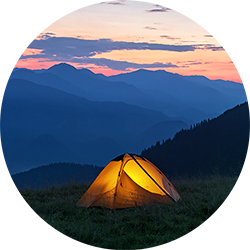


Which are the best budget camping tours in Jaisalmer, price starts from INR 1100?
Jaisalmer, also known as the golden city is extremely famous for camping and desert safari, check out below to experience camping in Jaisalmer price starts from INR 1100.
Camping In Jaisalmer
Explore All (7)
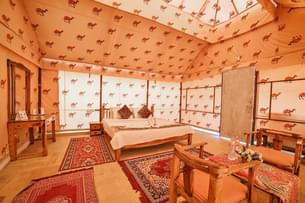
- 2D/1N
₹ 6,300
₹ 5,400
per room
.jpg?w=305&h=230&dpr)
- 2D/1N
₹ 3,750
₹ 3,000
per room
.jpg?w=305&h=230&dpr)
- 2D/1N
₹ 8,250
₹ 6,600
per room
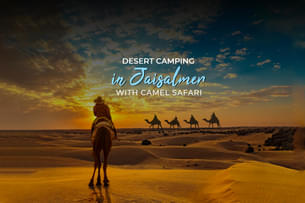
- 2D/1N
₹ 2,400
₹ 1,920
per adult
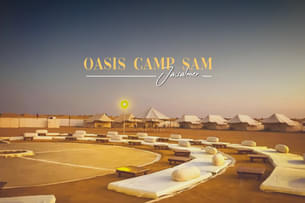
- 2D/1N
₹ 2,900
₹ 1,950
per adult
.jpg?w=305&h=230&dpr)
- 2D/1N
₹ 10,500
₹ 8,400
per room
.jpg?w=305&h=230&dpr)
- 2D/1N
₹ 19,500
₹ 15,600
per room
Best Selling Jaisalmer Tour Packages: Upto 30% Off
Explore All (56)
.png?w=305&h=230&dpr)
- 8D/7N
₹ 51,769
₹ 36,769
per adult
Send Enquiry
- 6D/5N
₹ 64,122
₹ 48,212
per adult
Send Enquiry
- 9D/8N
₹ 46,816
₹ 35,200
per adult
Send Enquiry
- 7D/6N
₹ 63,904
₹ 49,925
per adult
Send Enquiry
.jpg?w=305&h=230&dpr)
- 6D/5N
₹ 25,100
₹ 17,899
per adult
Send Enquiry
- 7D/6N
₹ 66,060
₹ 49,625
per adult
Send Enquiry
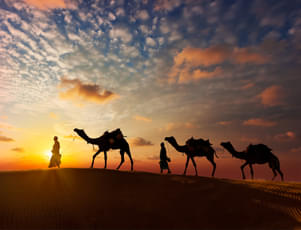
- 5D/4N
₹ 58,520
₹ 44,000
per adult
Send Enquiry
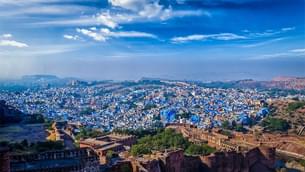
- 8D/7N
₹ 31,200
₹ 24,870
per adult
Send Enquiry
Jaisalmer Top Attractions
Places To Visit In Jaisalmer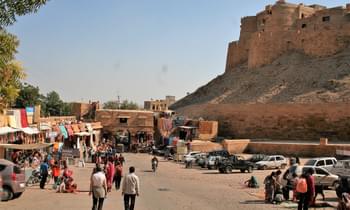
Manak Chowk
Manak Chowk, situated within the majestic Jaisalmer Fort, is a bustling square that epitomizes the city's vibrant culture and historical significance. Lined with intricately carved havelis and adorned with Rajasthani architecture, it serves as the heart of the old city. The square bustles with activity as vendors sell colorful textiles, traditional handicrafts, and aromatic spices. It is a melting pot of culture, where locals and tourists converge to experience the essence of Jaisalmer.In the evenings, the Chowk transforms into a lively marketplace illuminated by lanterns, offering a delightful fusion of sights, sounds, and smells. Surrounded by ancient structures that echo tales of bygone eras, Manak Chowk stands as a testament to the city's enduring heritage and its role as a vibrant center of commerce and culture in the Thar Desert.
Read More

Bada Bagh
Located at an equal distance both from Lodhruva and Jaisalmer, Bada Bagh is one of the most significant relics of our country. Featuring a series of cenotaphs, Bada Bagh portrays illustrious past of Rajasthan. Explore Bada Bagh's historic charm on your Jaisalmer tour adventure. Gleaming through the desert regions of Jaisalmer, Bada Bagh once was wrapped within a coat of lush green gardens. The famous golden cenotaphs at Bada Bagh are located at a distance of 6 km from the northern region of Jaisalmer.According to the Hindu literature, the term ‘Bada Bagh’ signifies a big garden. While the structure was first constructed, it had a beautiful garden encircling it. This might be the reason as to how and why the place came to be known as Bada Bagh. Perhaps today, you won't mark the presence of any garden there. But for sure, the site is quite peaceful with golden cenotaphs arising from the golden stretch of land. It has been said that every single cenotaph here is honored to be constructed in the memory of either a king or a queen from the royal family that stayed here.These cenotaphs are nothing but tomb shaped structures which are locally referred to as Chhatris. The art of constructing Chhatris began somewhere around the 17th century and lasted until the 20th century. The first cenotaph that marked its presence here was erected as a tribute to the Maharaja Jai Singh II. After that, different Chhatris were constructed, which differ widely in their sizes.Today, you could see them standing tall in two rows reflecting the power quotient and the social status of the members of the Royal family. If you look closely at the top of each Chhatri, there’s a small stone inscription there with the date and the name of the person to whom it has been commemorated. Very few of them have brief descriptions, as well.History of Bada BaghThe credit for the construction of this piece of land goes to the Maharaja Maharawal Jai Singh. He started his work by constructing a dam in the desert region so that it could serve the purpose of a water tank for the nearby villages. Soon, the water from this dam brought unparalleled glory to the entire periphery, and the region witnessed a surprising bloom in both its flora and fauna. This delighted every boon of efforts that Maharaja Maharawal Jai Singh invested into the construction of his venture.With his death on 21st September 1743, it was his son to commemorate him with the construction of a Chhatri here. The creation of this commemorable structure in the immediate neighbor of the lake laid the foundation of a new tradition for all the Bhatti dynasty rulers. After that, to recognize and valor the contribution of each of its Bhatti dynasty rulers, a new cenotaph came to be constructed.It was in the year 1947 when this tradition of cenotaph construction was discontinued on account of the sad demise of one of the princes who passed away after suffering from a mysterious disease. This death was considered to be a reflection of lousy omen amongst the Royals. Hence, they inanimate on the discontinuation of the tradition.The Chattris at Bada BaghBada Bagh witnessed a tradition of constructing Chattris somewhere around the 17th century, which lasted until the 20th century. The first Chattri or cenotaph, which came to be built here, was that of Maharaja Jai Singh II, who ruled the region between 1688 to 1743. He made immense contributions as a ruler during his reign in Jaisalmer. The major one was the dam construction, which was aimed at uplifting both flora and fauna in the community for the betterment of the society. After his death, his son decided to commemorate his valuable contribution towards social development by constructing a cenotaph near to this water body.This laid the foundation of a new tradition in the Bhatti dynasty. Later, it was decided that upon the demise of every royal king and queen of the Bhatti dynasty, a new cenotaph would be constructed here in his or her memory. However, this tradition came to be discontinued by the mysterious demise of Maharaja Jawahar Singh. Every single chhatri at the Bada Bagh has got its own height and appear in two different rows.They are built in such a way that each one reflects the power quotient of the ruler to which it has been associated with. In short, the more powerful a king or queen stood during his reign, the tall his Chhatri would stand. At the top of each Chhatri, there’s a stone inscription reflecting the date and the name of the king or queen to whom it has been honored to. On some of them, you would even witness a brief description, as well.
Read More
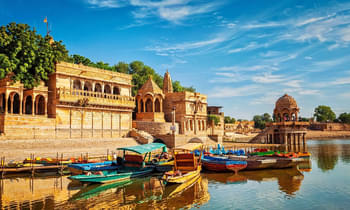
Gadisar Lake
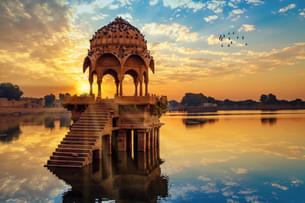
Located in the Thar Desert and almost 30 km away from Pakistan border, The Golden City of India, Jaisalmer houses plenty of historical monuments at present. Explore Gadisar Lake on your Rajasthan trip for scenic tranquility.Among the most striking man-made features of Jaisalmer is the Gadisar Lake. Built amidst the arid region of Rajasthan, this lake impersonates the beauty of an oasis.Located on the outskirts of Jaisalmer, visiting Gadisar Lake would be rated as one of the best things to do in Jaisalmer for watching the sunrise.This manmade lake built around the 12th-13th century is now a popular spot with visitors. It is an ideal getaway for architecture lovers, culture enthusiasts, and peace seekers. For a relaxing experience in Jaisalmer, visit this place while you are entitled to soak in the mesmerizing view of the sun setting down in the evening.Whether you like to spend some quiet time by yourself or have fun with your family and friends, Gadisar Lake has a handful of experiences to offer. You might want to begin with taking a tour around Gadisar Lake. Explore the beauty of the lake while you take a walk and watch some migratory birds flying around it. Moreover, you can visit the Desert Culture Centre and Museum for indulging into the historical aspects of Jaisalmer.With intricately carved temples and Tilon ki Pol, the city welcomes you into the beautiful Gadisar Lake. It is situated close to Jaisalmer fort and temples. Mention below is a rundown of the perfect options for a blissful experience of Gadisar Lake.
Read More
.jpeg?w=350&h=210&dpr)
Patwon Ki Haveli
Known as the golden city of India, Jaisalmer is a beautiful city in Rajasthan. Among all the things that make this city popular, “Patwon Ki Haveli,” also known as the Mansion of Brocade Merchants tops the list.Patwon Ki Haveli is a cluster of five large havelis in Jaisalmer. Built in 1805 by Guman Chand Patwa, it took the workers almost 55 years to complete the first haveli. With an interesting history, Patwon Ki Haveli is actually the first and the largest haveli to be constructed in Jaisalmer. History says that Patwa was an extremely wealthy man and a well-known trader of his time. Due to his riches, he could afford to build a luxurious palace and thus ordered the construction of separate stories – one for each of his five sons. The entire family dealt in gold and silver threads that were used in embroidering clothes and so, there was no dearth of money in the family. Discover the enchanting allure of Jaisalmer with our Jaisalmer package, offering a blend of golden landscapes, historic forts, and cultural richness.Once home to the Patwa family, today the cluster of havelis is occupied by the Rajasthan government’s art and craft department. Its beautiful architecture, creative mirror work, intricate carvings, lovely paintings, and its rich goldish yellow color is what makes this cluster of havelis a favorite among tourists and locals alike.
Read More
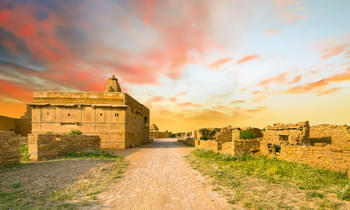
Kuldhara Village
Ghost stories have a very different kind of charm to lure readers with old forts, ruins of castles, deserted alleys, sinister houses and abandoned spirits. Explore the enigmatic Kuldhara Village on your Jaisalmer trip package, delving into its deserted charm and unraveling the intriguing tales within. Lying 21 Km from Jaisalmer in Rajasthan, Kuldhara village has a similar story to tell. At present Kuldhara Village is a heritage site and is maintained by the Archaeological Survey of India (ASI). As you enter the premises of this ancient village you can feel as if time has stood still in Kuldhara since the last 200 years. Straight dusty roads with intermittent rows of mud houses, cul-de-sac lanes and sandstone walls and a temple once visited by the Paliwals stand as a living testimony of some sad past. To the east of the village lies the parched river bed of Kakni which is a warning to the impossibility of sustenance of life in this place. An erstwhile flourishing village of North-Western India whose history dates back to the 13th century was abandoned overnight in 1825 for some reason unknown. As you walk along the ruins of Kuldhara village you can witness the ravages of time on its soil. However, the place does not have any supernatural fact behind its myth but a veil of sadness rends the air narrating the unfortunate past of its natives who were forced to leave their ancestral place under the cover of darkness. History Of Kuldhara Village -Kuldhara village was founded in 1156 by Jaisel Bhati atop the Trikuta Hill in Jaisalmer in Rajasthan.The purpose of building a settlement in such a place was due to the reason that the original capital Lodarva was under the threat of attacks by the enemies.The place around the Trikuta Hill had a smooth trade route with Persia and Arabia in the Middle East by land and also through the ports of Gujarat.As a result, they used to earn handsome revenues due to levied taxes from the caravans who used to travel from these places to Rajasthan. Subsequently, the invaders travelled from Afghanistan and used this route to plunder the wealth from Gujarat and the Somnath Temple in particular, that was known for its assets. For protecting themselves from the attacks of the invaders, the villagers abandoned Kuldhara and its adjacent villages as men, women and children were being held captive by the intruders and enslaved thereafter.
Read More

Desert National Park
Situated at a distance of around 40 km from Jaisalmer (Rajasthan), Desert National Park is counted amongst the largest parks of India. Geographically, this park covers an area of 3162 sq. km extending from the borders of Jaisalmer, the park boundary reaches close to the Indo-Pak border. Explore Desert National Park, Jaisalmer, on your Jaisalmer package for wildlife encounters.You can expect everything here that a Desert ecosystem has to offer you. There are craggy rocks, intermedial areas, compact salt lake bottoms, and fixed dunes. In fact, the dunes makeup to almost 20% of the area under this park. Amongst the wild flora of the Desert region, you get to see Desert plants, cacti, and other thorny bushes. An adventure-filled safari will be the best way to take a 360-degree tour of the Desert ecosystem here. Besides jeep drive, if you are really adventurous, you can indulge in camping and bonfire activities here. Being located within the close proximity of the Thar Desert, the park re-defines all parameters of stereotypical transitions exhibited by flora and fauna there. Even though the Desert ecosystem at the Desert National Park is harsh and fragile, it shelters a plethora of wildlife.In fact, bird researchers tag this place as a haven for migratory birds. If you are an avid lover of the rare bird species, get your binoculars and DSLRs on as you have The Great Indian Bustard to spot here. If you take a keen interest in exploring the Desert National Park, you will come across some remnants dating back to the era of Jurassic times. So, be ready to stare at the remnants of the dinosaurs dating back to around 6 million years.The park has also got animal and bird fossils dating back to 180 million years. So, get set and go as you and your DSLR has got a lot of hard work here. Flora and Fauna at Desert National Park –Excited to know more about the Desert National Park? Let’s peep into its flora and fauna first – 1. Animals – Desert monitors, deadly vipers, spiny-tailed lizards, Krait, and sandfish are the prominent members of the wildlife family. If you are fortunate enough to be there on time, you can even spot on Desert and Bengal foxes munching on some fresh berries. Apart from these key animals, the Desert National Park also shelters Vulpes, Blackbuck Antelope, Gazelle gazelle, Desert Cat Felis Libyes, and Cervicapra Rajputana Chinkara. 2. Birds – As stated early, this park is never-ending heaven for all bird lovers. Desert National Park of Jaisalmer is known to house 150 different varieties of residential and migratory birds. It is a common phenomenon to locate endangered species of The Great Indian Bustard. Amongst the other common species you have – Demoiselle, Eagles, Falcons, Partridges, Bee-Eaters, Vultures, Larks, Shrikes, Macqueen’s Bustard. As you move on to the next section of the park, you will come across some ponds and waterholes. Larks and wheatears are common species to be located here. 3. Reptiles – Not all, but Desert National Park has surely got several reptile species to exhibit before you. Monitor lizard, Spiny-tailed lizard, Russell’s viper, Saw-scaled viper, common krait are few of the reptile species to be traced here. 4. Vegetation – Although a sparse one, you still can find a variety in the vegetative species at the Desert National Park. Prominent amongst the vegetative species are aak shrub, sewan grass, and cacti. It has got a well-diversified desert type of landscape where you have small salt lake bottom, fixed and shifting dunes, and craggy rocks. While strolling through the park, do not forget to raise your head high above the sky. You will be surprised by the number of vultures soaring high to present a delightful sight.
Read More

Tazia Tower
An enigmatic architectural design including a series of grand balconies towering up to 5 stories of seamless contour, Tazi Tower in Jaisalmer is one of the greatest tourist attractions of the city. Found at the Badal Palace Complex, the tower is praised for its design and a strong ancient history it carries with it. Various balconies of the Tazia Tower also have a striking resemblance to the shrine which is a prime element in a number of Islamic festivals and the Muslims craftsmen designed it in such a way to pay tribute to their religion. Explore Tazia Tower's architectural beauty on your Jaisalmer trip package, witnessing its unique craftsmanship and charm.The tower comprises 5 floors, each holding a significant insight into the royal families it has been home to. Additionally, each of the floors also holds a uniquely crafted balcony, magnificent designs, and carvings on the walls and ceilings reflecting the creative advancement of crafters during the era. The tower is said to have been constructed in 1886 AD as a present to the Hindu ruler of the time, Maharawal Berisal Singh by local Muslim architects and craftsmen. The multistoried design embedded with a multitude of crafts and features makes tourists who visit the place get aw struck. Furthermore, it also has become one of the favorite places for national and international tourists to visit. All in all, from someone who is on a family vacation trying to learn a bit about India's ancient culture to an architecture enthusiast, the Tazia tower comes across as a breath of fresh air and a place one must not skip to visit especially if they are visiting Jaisalmer. History of Tazia TowerThe mesmerizing tower of Tazia was constructed in 1886 AD. It was built as a gift to the royal Hindu ruler of the time, Maharawal Berisal Singh. Built by local Muslim architects and craftsmen, the glorious tower was designed with the essence of the Islamic Religion. The tower is segregated into 5 stories each displaying a distinct blend of Muslim craftsmanship and design. Each floor also has giant balconies that were made to depict the Islamic tomb that is a sign of their religious festivities. The tower itself is also an edition of various Muslim Imams mausoleum. The same is displayed through the cravings on the walls of the monument using thermocol, colored papers, and wood and hence, the tower looks greatly different from all the other Rajputana forts and towers in the city. The tower also comprises of a number of ancient designs and structural pattern that was celebrated during the era. More than a tower, Tazia is respected as a depiction of the Islamic culture and tradition. Moreover, after becoming a heritage site the tower has been carefully maintained allowing tourists to explore its intricate beauty. Established in the heart of the city, the place is a major attraction for tourists.
Read More
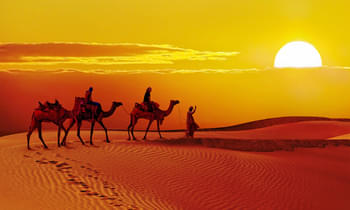
Sam Sand Dunes
Imagine yourself amidst the desert, the yellow sandstone buildings surrounded by the glorious dunes, and further enhanced by the golden rays of the sun. This is what a trip to Sam Sand Dunes feels like. This marvellous beauty of Rajasthan is an amazing cultural hub. Stretched across the Thar desert, Sam Sand Dunes is a prominent part of Jaisalmer. Explore Sam Sand Dunes on your Jaisalmer tour for desert adventures.One of the most idyllic places to wind down and get in touch with nature, you can explore here the plant and animal life too. Take a camel ride and go on a remarkable trip to tour the dunes. Or, rent a quad bike for a thrilling experience across the local villages. Many desert campsites organise cultural programs for visitors to witness the Rajasthani culture. There, you can witness musical nights, folk dance, puppet shows, and a chance to taste the aromatic Rajasthani cuisine.Indulge in stargazing, stay at the beautiful desert camps, and explore the vivid desert life. With all this and more, the Sam Sand Dunes are one of the most popular sites for offering a worthwhile experience to its visitors.
Read More
More Jaisalmer Attractions
Jaisalmer War Museum
Khuri Sand Dunes, jaisalmer
Khaba Fort Jaisalmer
Vyas Chhatri , jaisalmer
Tanot Mata Temple , jaisalmer
Salim Singh Ki Haveli, jaisalmer
Bada Bagh, jaisalmer
Gadisar Lake , jaisalmer
Patwon Ki Haveli, jaisalmer
Kuldhara Village, jaisalmer
Desert National Park, jaisalmer
Tazia Tower, jaisalmer
Sam Sand Dunes , jaisalmer
Jaisalmer War Museum
Khuri Sand Dunes, jaisalmer
Khaba Fort Jaisalmer
Vyas Chhatri , jaisalmer
Tanot Mata Temple , jaisalmer
Salim Singh Ki Haveli, jaisalmer
Nathmal Ki Haveli Jaisalmer
Lodhruva Jaisalmer
Nathmal Ki Haveli Jaisalmer
The Date Farm, jaisalmer
Longewala War Memorial, jaisalmer
Jain Temples, jaisalmer
Jaisalmer Fort
Jain Temples, jaisalmer
Bhadariya Library, jaisalmer
Jaisalmer Fort
More Things to do in Jaisalmer
Adventure in Jaisalmer
In City in Jaisalmer
Desert Safari in Jaisalmer
Weekend Tours in Jaisalmer
Jeep Safari in Jaisalmer
Sightseeing in Jaisalmer
Local Experiences in Jaisalmer
Camel Safari in Jaisalmer
Walking in Jaisalmer
ATV Ride in Jaisalmer
Parasailing in Jaisalmer
Aerial Sports in Jaisalmer
Dune Bashing in Jaisalmer