

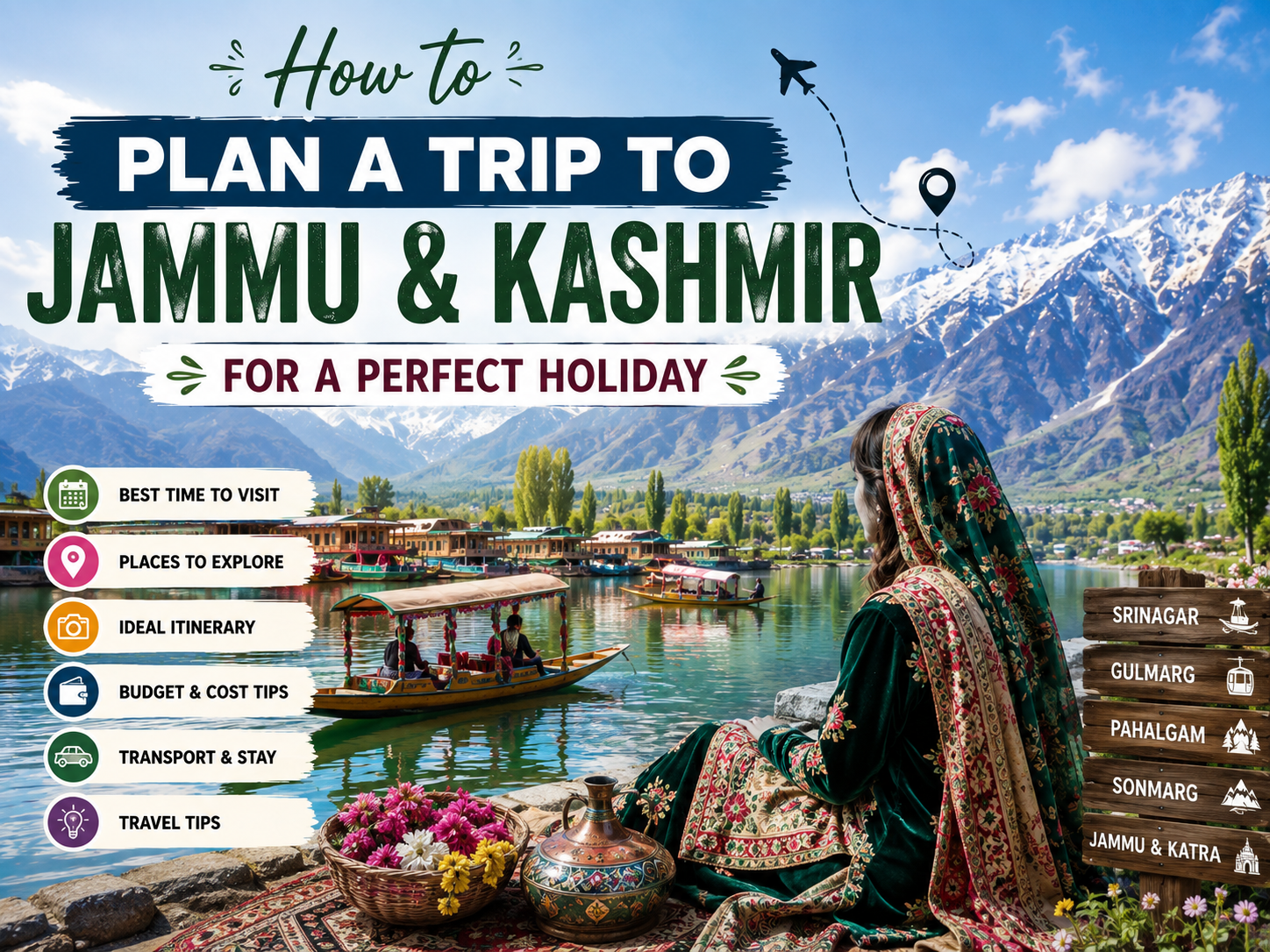
Quick Jumplinks to Navigate
A trip to Jammu and Kashmir can look deceptively simple on a map: Srinagar, Gulmarg, Pahalgam, perhaps Sonmarg, and you’re done. However, knowing how to plan a trip to Jammu and Kashmir is really about understanding how these places fit together, how long the mountain roads take and what each season actually offers. Get that right, and you can spend more time enjoying the valley instead of constantly packing and unpacking.
The interesting part is that each season gives you a slightly different Kashmir. Winter brings snow-covered Gulmarg and winter activities. Spring brings blooming gardens and pleasant weather, while autumn transforms the valley with its golden colours. That means your travel dates should be decided alongside your itinerary, rather than after you’ve already chosen where to go.
Considering the amount of planning that goes into such a trip, for travellers who prefer some of the logistics handled for them, Thrillophilia’s Jammu and Kashmir tour packages bring together stays, transfers and sightseeing across applicable itineraries. Routes can be planned around the season, trip duration and experiences you want to prioritise, making it easier to enjoy the destination without coordinating every booking yourself.
The best Jammu and Kashmir itinerary is not the one that covers the most places, but the one that gives you enough time to actually experience them. That is why we have put together this Jammu and Kashmir travel guide to help you plan the practical details, from choosing destinations and the best time to visit to budgeting, transport and building a realistic itinerary.
Start by Deciding How Many Days You Need
Your trip duration should determine how much of Jammu and Kashmir you try to cover. At Thrillophilia, our post-trip feedback across 41,700+ Jammu and Kashmir traveller reviews has shown a clear pattern in what works for different trip lengths.
Travellers on 3 to 4 day breaks tend to prioritise Srinagar with either Gulmarg or Pahalgam tours, while those travelling for 5 to 6 days often prefer covering the core Kashmir circuit. With 7 to 8 days, travellers have more room for Sonmarg and slower sightseeing, while 9 to 10 day trips are better suited to adding Jammu, Katra or an offbeat destination without making the itinerary feel rushed.
| Trip duration | What you can comfortably cover |
| 3–4 days | Srinagar + one destination such as Gulmarg or Pahalgam |
| 5–6 days | Srinagar + Gulmarg + Pahalgam, with Sonmarg as an excursion |
| 7–8 days | Srinagar + Gulmarg + Pahalgam + Sonmarg, with more leisure time |
| 9–10 days | Kashmir Valley plus Jammu/Katra or an offbeat destination |
For a first-time visitor, trying to cover Jammu, Katra, Srinagar, Gulmarg, Pahalgam and Sonmarg in five days will leave very little time to actually experience each place. Mountain roads, weather and sightseeing stops can all stretch travel days.
Based on the routes Thrillophilia’s on-ground team has operated, 5 to 6 days works particularly well for the classic Kashmir circuit, while longer itineraries make more sense when travellers want Jammu, Vaishno Devi or less-visited destinations included.
Choose the Right Places to Visit in Jammu and Kashmir
You don’t necessarily need every destination. Start with the experiences you want and then choose your preferred places to visit in Kashmir and Jammu accordingly.
- Srinagar: A Srinagar tour package will allow you to experience the best of Dal Lake, shikara rides, houseboats, Mughal gardens and local markets.
- Pahalgam: Better suited to slower days, meadows, rivers and excursions towards places such as Betaab Valley and Aru.
- Sonmarg: A strong choice for mountain scenery, glaciers and high-altitude landscapes.
- Gulmarg: A trip to Gulmarg is ideal for snow, skiing, the Gulmarg Gondola and alpine landscapes.
- Jammu and Katra: Add these if Vaishno Devi, temples or Jammu’s heritage are an important part of your trip.
- Doodhpathri, Yusmarg or Gurez: Consider these if you’ve already covered the classic circuit and want something quieter.
This is where itinerary experience becomes useful. Over years of planning Kashmir holidays, Thrillophilia has seen that first-time families and couples generally get more value from the Srinagar–Gulmarg–Pahalgam circuit, while repeat travellers are more likely to enjoy adding destinations such as Doodhpathri or Yusmarg. The official J&K tourism network itself lists destinations ranging from Gurez and Doodhpathri to Yusmarg and Warwan, so there is considerably more to the region than the standard three-city route.
Pick the Best Time to Visit Jammu and Kashmir
There isn’t one universally best month, so these Jammu and Kashmir travel tips to choose the right season depend largely on what you want to see and experience.
| Season | Best for | What to expect |
| March–April | Tulips, spring landscapes | Tulip Garden season, pleasant valley weather and snow at higher elevations |
| May–June | First-time trips, families | Comfortable weather, green meadows and peak tourist demand |
| July–August | Green landscapes | Lush valleys, lighter rainfall than much of India, but possible traffic around pilgrimage routes |
| September–October | Fewer crowds, photography | Pleasant weather and autumn colours, particularly towards October |
| December–February | Snow and skiing | Gulmarg snow, skiing and winter experiences |
Spring and autumn can be particularly rewarding if you want pleasant weather without the intensity of the summer rush. September–October can also work well for a budget Kashmir tour, with fewer crowds, pleasant weather and lower demand than the peak summer months. Winter is a different proposition altogether: if snow and skiing are your priority, Gulmarg becomes the focus rather than trying to follow a standard summer itinerary.
Current destination updates from our on-ground team operating Jammu and Kashmir tours have placed December–February among the strongest periods for snow-based experiences, while April–May and September–October are popular for broader sightseeing.
Jammu and Kashmir holiday planning tip: Don’t assume that because Srinagar is comfortable in summer, Gulmarg or Sonmarg will feel the same. Higher-altitude destinations can remain significantly colder, so pack layers even when travelling in warmer months.
Plan How You’ll Reach Jammu and Kashmir
For most travellers, Srinagar Airport (SXR) is the most convenient entry point for a Kashmir Valley itinerary. If you’re combining the trip with Vaishno Devi or Jammu, Jammu Airport (IXJ) or Jammu railway station can make more sense.
A simple way to decide:
- Kashmir-focused trip: Fly into Srinagar.
- Vaishno Devi-focused trip: Reach Jammu and continue to Katra.
- Jammu + Kashmir circuit: Consider arriving in Jammu and departing from Srinagar, or vice versa, depending on flight availability.
This avoids unnecessary backtracking. For example, if you’re doing Jammu, Katra, Srinagar, Gulmarg, and Pahalgam, in this order, returning to Jammu solely for your flight home adds another long transfer that you may not need.
Build Your Jammu and Kashmir Trip Itinerary Around Travel Time
One of the biggest Jammu and Kashmir holiday planning mistakes is treating distances on a map like ordinary city-to-city travel.
A route that looks short can take considerably longer because of mountain roads, traffic, weather and sightseeing stops. This is why a good Jammu and Kashmir trip itinerary usually uses day excursions and logical overnight stops, rather than changing hotels every night.
A comfortable first-time route for a 5-day Kashmir itinerary could look like:
Day 1: Arrive in Srinagar and explore the city
Day 2: Srinagar sightseeing and Dal Lake
Day 3: Gulmarg excursion
Day 4: Travel to Pahalgam
Day 5: Pahalgam and nearby valleys
Day 6: Return to Srinagar and depart
For seven days, you can add Sonmarg and more leisure time in Srinagar. Thrillophilia’s existing 5-day itinerary follows the broad Srinagar–Sonmarg–Pahalgam–Gulmarg structure, while its seven-day route allows additional time across the same core destinations.
Budget for Your Jammu and Kashmir Trip
Your final Jammu and Kashmir trip cost depends heavily on the season, hotel category, transport and activities.
For a 6-night/7-day trip excluding flights, a broad planning range could be:
| Travel style | Approx. cost per person |
| Budget | INR 18,000–INR 25,000 |
| Mid-range | INR 28,000–INR 45,000 |
| Premium | INR 50,000–INR 75,000+ |
Accommodation, private transport and activities such as the Gulmarg Gondola can move the total considerably. When exploring with Thrillophilia, packages also span a wide range, from around INR 17,500 for shorter Jammu and Kashmir trips to INR 1,31,600 for premium honeymoon Kashmir itineraries, depending on duration and inclusions.
Rather than comparing only the starting price, check what is included. Accommodation, transfers, sightseeing, meals and activities can otherwise become separate expenses.
Keep Transport Flexible in the Hills
For anyone wondering how to plan a trip to Jammu and Kashmir, a private cab is often the most practical option for most Kashmir itineraries, particularly for families and couples. It lets you adjust departure times, stop at viewpoints and avoid coordinating multiple local connections.
However, not every activity should be treated as part of the vehicle transfer. Certain local sightseeing areas and experiences can have separate transport arrangements or charges.
If you’re visiting Gulmarg in winter, for example, weather can affect road conditions and sightseeing schedules. Building some flexibility into the Jammu and Kashmir trip itinerary is more useful than planning every hour around a fixed timetable.
Thrillophilia’s Kashmir operations team specifically flags weather and road conditions as factors worth allowing buffer time for, particularly in winter and high-altitude areas. Applicable packages combine accommodation, transfers and sightseeing, while the itinerary can be customised according to the traveller’s preferred pace.
Plan Your Kashmir Experiences in Advance
Some experiences are worth planning before you arrive rather than deciding on the spot.
Depending on the season and itinerary, these top things to do in Kashmir can include the following:
- Shikara ride on Dal Lake
- Gulmarg Gondola
- Skiing and snow activities
- Houseboat stay
- Mughal Gardens
- Betaab Valley and Aru Valley
- Local Kashmiri cuisine and markets
- Trekking or other outdoor activities
Gulmarg Gondola is particularly important to plan around during busy periods because availability can influence your sightseeing schedule. Similarly, winter activities depend heavily on snow conditions.
The best itineraries don’t simply add every available activity. They leave enough time between experiences to account for transfers, weather and the fact that sometimes the most memorable part of Kashmir is simply having an unhurried afternoon by the lake or in the mountains.
Keep a Buffer for Weather and Local Conditions
Kashmir’s landscapes are a major part of the appeal, but mountain travel also means conditions can change quickly.
Keep some flexibility for:
- Snowfall or rain affecting road journeys
- Traffic on popular routes
- Delays around peak tourist periods
- Changes to high-altitude sightseeing
- Seasonal closures or restricted access
This becomes especially relevant if your itinerary includes Sonmarg, Gulmarg or remote valleys. The destination may be only one part of the equation; whether you can comfortably reach and explore it on a particular day matters just as much.
How to Plan a Trip to Jammu and Kashmir with Thrillophilia
A good Jammu and Kashmir trip should leave you with more than a checklist of famous viewpoints. Give Srinagar enough time for its lakes, gardens and local culture, use Gulmarg for mountain and snow experiences, let Pahalgam have slower days, and add Jammu or an offbeat destination only when your duration allows it.
Thrillophilia’s experience across Kashmir routes has similarly shaped its itineraries around this balance. Its current offerings include classic 5–6-day Kashmir circuits, longer holidays, honeymoon trips, family Kashmir itineraries and Jammu–Kashmir combinations with Vaishno Devi. The destination operations teams also use traveller feedback and booking patterns to refine route duration and experiences.
That approach matters because the best Jammu and Kashmir itinerary isn’t necessarily the one that covers the most places. It is the one where the route, season, accommodation, transport and experiences work together without making you spend the entire holiday on the road.
FAQs
5–7 days is a good duration for a first Kashmir trip covering Srinagar, Gulmarg and Pahalgam, with Sonmarg added depending on the itinerary. Add a few more days if you also want Jammu and Vaishno Devi.
For general sightseeing, April to June and September to October make the best time to visit Jammu and Kashmir. Visit between December and February if your priority is snow and skiing in Gulmarg.
A 6-night/7-day Jammu and Kashmir trip can broadly cost INR 18,000–INR 75,000+ per person excluding flights, depending on accommodation, transport, season and activities. Premium or honeymoon itineraries can cost considerably more.
For a first visit to Kashmir, Srinagar, Gulmarg and Pahalgam form the most practical core itinerary. Sonmarg can be added if you have enough time.
Include them if pilgrimage or Jammu sightseeing is an important part of your holiday. Otherwise, a shorter Kashmir-focused itinerary can give you more time in the valley. Thrillophilia also offers combined Jammu–Kashmir and Vaishno Devi itineraries for travellers who want to cover both experiences.