

Quick Jumplinks to Navigate
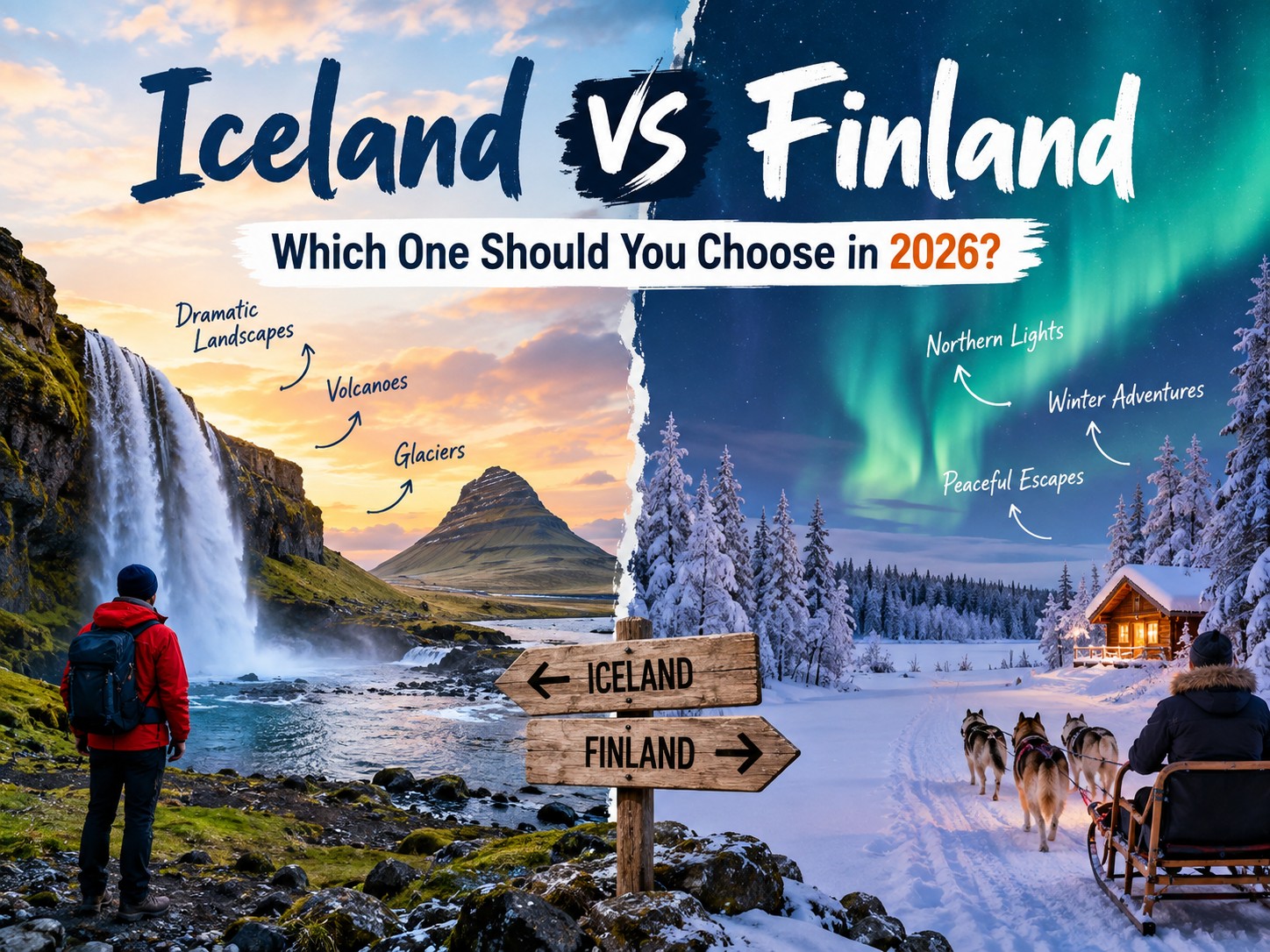
For many travellers, the appeal of a Nordic holiday starts with the same things: unique landscapes, winter adventures and the possibility of seeing the Northern Lights. That makes a comparison of whether to choose Iceland or Finland easy, but the final decision can be quite difficult once you look at what a typical holiday in each country actually involves.
In Iceland, the journey is as much about the scenery as the destinations, with waterfalls, glaciers, volcanic landscapes, black-sand beaches and geothermal lagoons forming the highlights. Finland offers a more concentrated Arctic experience, particularly in Lapland, where Northern Lights excursions sit alongside husky safaris, reindeer rides, Santa Claus Village and glass igloo stays.
In this guide, we’ll compare Iceland vs Finland on the things that can genuinely affect your holiday, from the overall cost and weather to accommodation, sightseeing, food, transport and the amount of time you need. We’ll also look at which one works better for honeymoons, family trips and different travel budgets.
This guide will also help you explore how you can have the logistics of your holiday handled through Iceland tour packages or Finland tour packages so you can focus more on the experiences and less on coordinating hotels, transfers and activities. When booking with Thrillophilia, packages can also be customised around your preferred experiences and pace of travel.
With that in mind, let’s compare the two destinations in detail and see whether Iceland’s landscape-driven adventures or Finland’s Arctic experiences are a better fit for your next holiday.
Iceland Vs Finland: Quick Comparison
If you want a quick overview before getting into the details, the table below compares Iceland and Finland on the factors that matter most when planning a holiday, including cost, duration, accommodation, weather and the overall travel experience.
| Parameter | Iceland | Finland |
| Best For | Glaciers, waterfalls, volcanic landscapes, geothermal lagoons and scenic road trips | Northern Lights, Lapland, husky and reindeer safaris, Santa Claus Village and glass igloos |
| Budget | From INR 1,63,000 per person for 6 days | From INR 1,70,000 per person for 5 days |
| Accommodation | 3 to 5-star hotels across Reykjavík and other itinerary stops | Hotels, Arctic resorts and glass igloo stays on selected packages |
| Ideal Trip Duration | 8 days for a first trip covering major highlights | 7 days for combining Helsinki with key Lapland experiences |
| Best Time to Visit | June–August for sightseeing; September–March for Northern Lights | December–March for snow and Northern Lights; June–August for Midnight Sun |
| Ease of Travel | More road travel between attractions; guided tours or self-drive are common | Helsinki connects easily with Lapland by flight or overnight train |
| Verdict | Better for landscapes, sightseeing and adventure | Better for Arctic activities, families and winter experiences |
Thrillophilia’s current Europe packages for both destinations offer different durations and itinerary styles. Now, let’s look more closely at the cost, experiences, weather, accommodation, food, transport and itineraries to see which destination works better for your particular trip.
Destination Overview
Iceland
Iceland is often described as the Land of Fire and Ice, and the name makes sense once you see how closely glaciers, volcanoes and geothermal landscapes exist alongside each other. The country is known for its dramatic scenery, with waterfalls dropping over cliffs, black-sand beaches stretching along the coast and geothermal pools tucked into rugged landscapes.
Reykjavík is usually the starting point for an Iceland tour package, but the city is only a small part of the experience. From here, travellers can head towards the Golden Circle to see Þingvellir National Park, Geysir and Gullfoss, continue along the South Coast for Seljalandsfoss, Skógafoss and the black-sand beaches around Vík, or travel farther east towards Jökulsárlón Glacier Lagoon and Diamond Beach. The Blue Lagoon and Northern Lights excursions add a different side to the itinerary.
Iceland is particularly rewarding when the route is planned around the geography rather than simply adding attractions to each day. Thrillophilia’s on-ground destination teams and local experts help plan these routes based on how travellers actually move between places, while pre-booking selected activities can also save time during a relatively short trip. Feedback collected from travellers after their holidays further helps refine the routes and experiences included in its Iceland itineraries.
Finland
Finland is known for its forests, thousands of lakes and, in the north, the Arctic wilderness of Lapland. While Helsinki offers an introduction to Finnish architecture, culture and the country’s famous sauna tradition, most travellers heading to Finland for a winter holiday have their sights set much farther north. Your trip can also cover Rovaniemi, Saariselkä and Inari, which rank among the best places to visit in Finland for Arctic activities, winter landscapes and Northern Lights experiences.
Rovaniemi is the main gateway to Lapland and is famous as the official hometown of Santa Claus. Around the city, travellers can experience husky safaris, reindeer sleigh rides, snowmobile excursions and Northern Lights tours. Those looking for a quieter Arctic setting can continue towards Saariselkä or Inari, where the lower levels of light pollution make them popular areas for aurora viewing. All the glass igloo stays in Finland also give travellers the chance to experience the winter landscape without giving up the comfort of a proper stay.
The Finland tour packages work particularly well when the route is planned around the time available. With 13+ years of destination experience, an on-ground network and local teams, Thrillophilia can help determine whether it makes more sense to combine Helsinki with Rovaniemi or spend more time in Lapland. Pre-booked activities, coordinated transfers and local assistance can also make a difference here, especially during the busy winter season when popular Arctic experiences can fill up quickly.
Iceland vs Finland: Detailed Comparison
Choosing between the two depends largely on the kind of holiday you want. An Iceland vs Finland comparison is useful because both are destinations in Europe that offer Northern Lights experiences, winter landscapes and memorable Arctic experiences, but the way you experience them is quite different. Iceland is more landscape-driven, while Finland, particularly Lapland, is more focused on Arctic activities and winter stays.
The following sections break down the main factors that can influence an Iceland or Finland holiday, from the cost and weather to experiences, food, transport and ideal trip duration.
- Iceland vs Finland Cost & Budget
- Experiences and Places to Visit in Iceland and Finland
- Weather & Best Time to Visit
- Iceland vs Finland Travel Comparison for Food & Vegetarian Meal Options
- Getting Around
- Sample Itinerary & Ideal Trip Duration – Iceland vs Finland Travel
Iceland vs Finland Cost & Budget
When comparing the cost of travelling to Iceland and Finland, the overall Iceland vs Finland cost can vary depending on the season, accommodation and experiences you choose. Iceland can become expensive with car rentals and multiple activities, while premium stays and Arctic experiences in Finland luxury tours can raise costs for this European destination.
| Cost Factor | Iceland | Finland |
| Starting Package Price | INR 1,63,000 (6D/5N) | INR 1,70,000 (5D/4N) |
| Return Flight from India | Around INR 55,000–75,000 | Around INR 45,000–70,000 |
| Accommodation | INR 6,000–10,000/night | INR 4,000–7,000/night |
| Meals | Around INR 3,000–5,000/day | Around INR 2,000–3,500/day |
| Internal Transport | Around INR 6,000–8,000/day | INR 500 (Helsinki city day pass) and INR 5,000 to 10,000 (Helsinki-Rovaniemi flight) |
| Major Activities | Glacier walks, ice caves, Blue Lagoon and guided tours | Husky safaris, reindeer rides, snowmobiles, Northern Lights and glass igloos |
| Best For | Scenic sightseeing and road trips | Arctic experiences and activity-led holidays |
For this reason, Finland vs Iceland is not simply a question of which country is cheaper. Budget travellers can find more manageable options in either, while Iceland budget tours can offer better value for travellers who prioritise sightseeing, and Finland can offer better value when several Arctic experiences are bundled together.
Experiences and Places to Visit in Iceland and Finland
The biggest difference in an Iceland vs Finland travel experience is what fills your days. Iceland’s attractions are spread across a landscape of volcanoes, glaciers, waterfalls and coastlines, whereas Finnish Lapland is more about entering an Arctic environment and participating in activities.
Here are some of the best things to do and places to visit in Iceland:
- Reykjavík: A compact base for museums, architecture, cafés and geothermal pools.
- Golden Circle: Þingvellir, Geysir and Gullfoss form Iceland’s best-known sightseeing circuit.
- South Coast: Seljalandsfoss, Skógafoss, Reynisfjara and glacier landscapes.
- Jökulsárlón: Floating icebergs and Diamond Beach create one of the country’s most recognisable landscapes.
- Blue Lagoon: A geothermal bathing experience surrounded by lava fields.
- Northern Lights: Best combined with a wider winter itinerary rather than making it the sole reason to visit.
Iceland’s USP is variety. Among all the amazing things to do in Iceland, you can spend the morning beside a waterfall, drive past glaciers in the afternoon and end the day in a geothermal pool.
Below is the list of the primary attractions and top things to do in Finland:
- Husky safaris: One of Lapland’s most popular winter activities.
- Reindeer rides: A slower way to experience the snowy landscape.
- Glass igloos: Particularly appealing for couples wanting an unusual Arctic stay.
- Rovaniemi: Santa Claus Village and the Arctic Circle are major inclusions in any Finland family tour.
- Northern Lights: Finnish Lapland has favourable conditions for aurora viewing, particularly from late August/September through March.
- Saariselkä and Inari: Better suited to travellers seeking quieter wilderness and darker skies.
This is where a debate on choosing an Iceland vs Finland holiday can feel completely different. Iceland suits travellers who want to keep moving between natural attractions, while Finland works better for those who want a handful of distinctive Arctic experiences built into a slower itinerary. For couples, Iceland honeymoon tours lean towards scenic adventure and geothermal experiences, whereas Finland offers a cosier combination of glass cabins, saunas, husky rides and aurora viewing.
Weather & Best Time to Visit
Weather can make a noticeable difference when planning an Iceland vs Finland trip, particularly because Finland’s Lapland is considerably colder in winter.
- Iceland: Coastal areas usually stay around -2°C to 3°C in winter, while summer temperatures are generally around 10°C–15°C. June to August is best for long daylight hours, road trips and sightseeing. September to March offers better opportunities and places for the Northern Lights in Iceland, although snow, wind and changing road conditions can affect travel.
- Finland: Lapland can see winter temperatures of around -10°C to -25°C, and occasionally lower, making December to March the best period for snow activities and Northern Lights. June and July are much milder, with temperatures generally around 15°C–25°C and the Midnight Sun.
One of the major planning insights Thrillophilia’s destination experts have figured out is how travellers often get more from Iceland when summer trips focus on sightseeing routes. On the other hand, Finland, as shared by our travellers, gives a better experience with winter itineraries that allow multiple nights in Lapland rather than treating the Northern Lights as a single-night activity. This also gives us enough time to reschedule an aurora outing for our travellers if cloud cover makes the first attempt unsuccessful.
- Best for sightseeing: Iceland in June to August.
- Best for a snowy Arctic holiday: Finland in December to March.
If you’re debating whether to choose Iceland or Finland for vacation, choose Iceland in summer if sightseeing and road journeys are your priority. Opt for Finnish Lapland between December and March if snow, Arctic activities and Northern Lights viewing matter most to you.
Iceland vs Finland Travel Comparison for Food & Vegetarian Meal Options
Food is unlikely to be the deciding factor in an Iceland or Finland holiday, but the experience differs slightly between the two. In Iceland, Reykjavík has the widest choice of international restaurants, while smaller towns along the South Coast have fewer options. Local food is centred around seafood, lamb, dairy and rye-based dishes. Finland has a similarly varied food scene in Helsinki, while Lapland is known for salmon, berries, potatoes, rye bread and local specialities such as reindeer.
Vegetarian travellers will find more variety in Reykjavík and Helsinki, where international restaurants are easier to find. In smaller Icelandic towns and remote Lapland resorts, options can be more limited. Indian food is also much easier to find in the capitals than in rural areas.
For Indian travellers, meal planning can therefore be useful, especially when an itinerary takes you away from Reykjavík or Helsinki. Thrillophilia includes daily breakfast in its packages, regardless of whether you choose Iceland or Finland, while lunch and dinner can be included depending on the package. This can be particularly useful for family tours in Iceland, where having meals planned in advance can make longer sightseeing days easier. Vegetarian and, where available, Jain meals can also be arranged when informed beforehand.
Having executed thousands of trips across Iceland and Finland, Thrillophilia’s on-ground teams have also built a practical list of Indian and vegetarian-friendly restaurants based on traveller feedback and post-trip reviews. Along your route, the team can suggest options such as Indian Street Food or Shalimar in Reykjavík and Ravintola Nili or Roka in Rovaniemi, depending on your itinerary and meal preferences. This is particularly useful outside the main cities, where restaurant choices can be more limited.
Getting Around
Getting around is one of the clearest differences in an Iceland vs Finland comparison.
Iceland is essentially a road-trip destination. Route 1 connects much of the country, and self-drive is popular, particularly between May and October. However, winter weather, wind, gravel roads and changing conditions mean travellers need to monitor road updates carefully. Guided tours and private transfers are useful alternatives if you do not want to drive.
Finland has a more extensive public transport network. Helsinki is easy to navigate using trams, buses, metro, trains and ferries, while Rovaniemi can be reached from Helsinki by a roughly one-hour flight or overnight train. Finnish trains and buses are generally reliable, making the country easier to navigate without renting a car.
This is also where planned trips can add practical value. Thrillophilia’s destination teams use local partners and traveller feedback to coordinate transfers, activity timings and pre-booked experiences. Solo travellers can also consider Iceland group tours for shared transfers and the chance to travel with other people, while private transfers can be arranged for travellers who prefer more flexibility. The same approach can be useful in Finland, particularly in Lapland, where winter schedules can make last-minute planning difficult.
Verdict: Finland is easier for travellers relying on public transport; Iceland is more rewarding for those comfortable with road travel or guided sightseeing.
Sample Itinerary & Ideal Trip Duration – Iceland vs Finland Travel
A good Iceland trip plan should leave enough time for the destination to breathe rather than trying to cover every attraction.
Iceland – 8 days
- Day 1: Arrive in Reykjavík and explore the city.
- Day 2: Cover Þingvellir, Geysir and Gullfoss on the Golden Circle.
- Day 3: Travel along the South Coast, stopping at waterfalls and black-sand beaches.
- Day 4: Continue towards glacier country and Jökulsárlón.
- Day 5: Explore the glacier lagoon and surrounding landscapes.
- Day 6: Return towards Reykjavík with a geothermal experience.
- Day 7: Keep time for Reykjavík, whale watching or a Northern Lights excursion.
- Day 8: Depart.
Thrillophilia’s current 8-day Iceland itineraries reflect this broad sightseeing-led format, while longer 10-day packages add more regional exploration.
Finland – 9 days
- Day 1: Arrive in Helsinki and explore the city.
- Day 2: Visit Helsinki’s major cultural and waterfront attractions.
- Day 3: Travel to Rovaniemi by flight or overnight train.
- Day 4: Visit Santa Claus Village and experience the Arctic Circle.
- Day 5: Take a husky or reindeer safari.
- Day 6: Head out for a Northern Lights experience or snowmobile activity.
- Day 7: Continue towards Saariselkä or spend another day in Rovaniemi.
- Day 8: Enjoy a final Arctic experience before returning.
- Day 9: Depart.
For travellers wondering whether to choose Iceland or Finland, the shorter trip is easier to justify in Iceland if the goal is to see several major landscapes, while Finland benefits from spending several nights in Lapland rather than constantly changing hotels. Thrillophilia’s Finland packages currently span 5–12 days, allowing shorter Arctic breaks as well as longer Helsinki tour packages with Lapland combinations.
Overall, an Iceland vs Finland tourism decision comes down to the kind of holiday you want to remember: Iceland for dramatic landscapes and active sightseeing or Finland for a slower, more immersive Arctic experience. That distinction is ultimately more useful than simply asking whether Iceland or Finland is the better destination.
Who Should Choose Which Destination?
Neither destination is universally better. The right choice depends on whether you want a landscape-focused journey through Iceland or a more immersive Arctic holiday in Finland.
| Choose Iceland If… | Choose Finland If… |
| You prefer glaciers, waterfalls, volcanoes and scenic drives | You prefer snowy forests and Arctic experiences |
| You have a mid-range to premium budget for sightseeing | You want flexibility across different budgets |
| You enjoy road trips, nature and outdoor exploration | You enjoy husky rides, reindeer safaris and snow activities |
| You’re travelling for adventure or a scenic honeymoon | You’re travelling with family or for a winter holiday |
| You want varied landscapes across one trip | You want Northern Lights and a cosy Lapland experience |
Overall, if you’re comparing destinations for an Iceland or Finland holiday, think about what you want to spend most of your time doing. Iceland offers dramatic coastlines, glaciers, waterfalls and volcanic scenery, whereas Finland is known for Lapland, Northern Lights excursions, husky rides, reindeer safaris and snow-based activities.
Final Verdict
The choice between Iceland and Finland ultimately comes down to the kind of holiday you want to build. Iceland stands out for its dramatic landscapes, road-trip routes and variety of natural experiences, while Finland offers a more focused Arctic holiday, particularly around Lapland, with Northern Lights, husky safaris, reindeer rides and glass igloo stays.
- Choose Iceland if you want glaciers, waterfalls, volcanoes, geothermal experiences and a sightseeing-heavy itinerary. It is also a stronger fit if exploring different landscapes is more important to you than staying in one Arctic region.
- Choose Finland if you want snow, Northern Lights and activity-led experiences, especially for a family holiday, a winter escape or a cosy Finland honeymoon trip in Lapland.
If you’re still deciding, exploring Iceland or Finland tour packages can help you see how different durations and itineraries work. Thrillophilia can also customise packages around your preferred experiences, budget and pace, including multi-destination itineraries where you want to cover more than one region in the same trip.
Why Choose Thrillophilia for Your Iceland or Finland Holiday?
Planning a Nordic holiday involves more than choosing between two destinations. Routes, weather, activity availability and travel time can all affect how much you actually experience, which is why understanding Iceland vs Finland tourism is useful before finalising your itinerary. With years of travel-planning experience, Thrillophilia has 15+ destination experts along with on-ground teams and traveller feedback to help build practical itineraries.
Thrillophilia has 3,000+ reviews for Iceland and 5,000+ for Finland, with both destinations rated 4.7/5 by travellers. Depending on your preferences, you can customise your Iceland vs Finland holiday with experiences such as Northern Lights excursions, glass igloo stays, glacier activities and pre-booked Arctic adventures.
You can also combine destinations where practical, while the local team helps coordinate stays, transfers and activities. For many travellers, this simply means having the practical details taken care of while still keeping enough flexibility to experience Iceland or Finland at your own pace.
FAQs
It depends on your travel style. Iceland is better for dramatic landscapes, waterfalls, glaciers, geothermal lagoons and scenic road trips. Finland is better for Arctic experiences such as Northern Lights, husky and reindeer safaris, Santa Claus Village and glass igloos. Families may prefer Finland, while adventure seekers may prefer Iceland.
Iceland is known for volcanic landscapes, glaciers, waterfalls, geothermal springs and black-sand beaches, while Finland, particularly Lapland, is known for forests, frozen lakes and Arctic wilderness. Iceland is more focused on sightseeing and natural landscapes, whereas Finland offers a more activity-led holiday with husky rides, reindeer safaris and Northern Lights experiences.
Finland is generally colder, particularly Finnish Lapland, where winter temperatures can fall to around -10°C to -25°C. Iceland has a milder coastal climate, although strong winds can make it feel considerably colder. If visiting Lapland in winter, carry proper thermal layers, insulated footwear, gloves and a warm outer layer.
Finland has a slight edge, particularly around Lapland’s Rovaniemi, Saariselkä and Inari, where dark skies support aurora viewing. You can also combine it with husky rides, reindeer safaris and glass igloos. Iceland is equally rewarding if you want to combine Northern Lights with glaciers, waterfalls, geothermal lagoons and volcanic landscapes.
Both are excellent but suit different honeymoons. Iceland works better for couples seeking dramatic scenery, geothermal lagoons, waterfalls and adventure. Finland is better for a cosy Arctic honeymoon featuring glass igloos, Northern Lights, husky rides and snowy landscapes. Choose Iceland for variety and adventure, or Finland for a romantic winter escape.