

Quick Jumplinks to Navigate
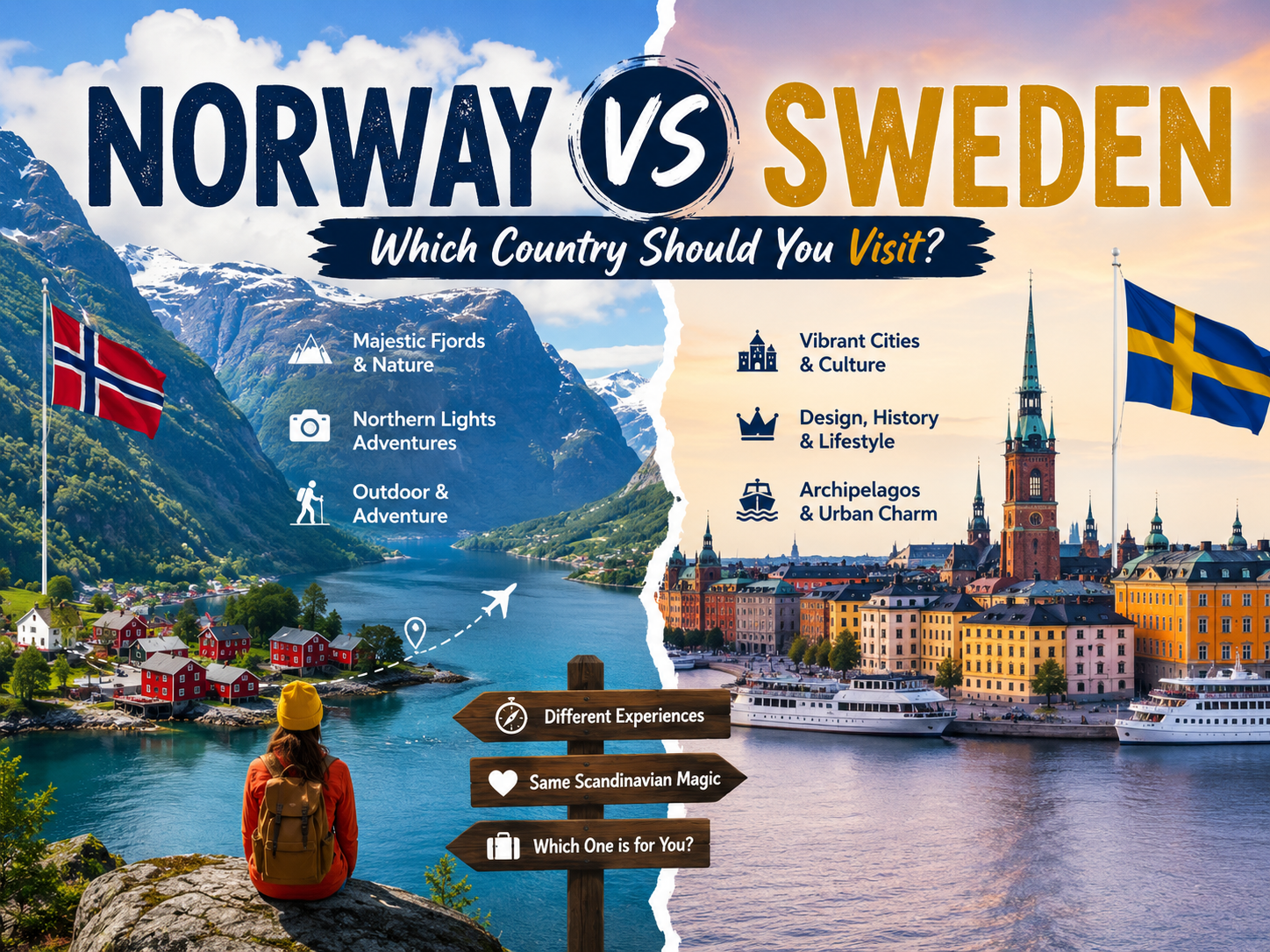
Bouncing between Norway and Sweden while planning for a Scandinavian trip is a true hustle. Surrounded by dramatic fjords and epic mountainscapes, Norway is best for outdoor trips and Northern Lights excursions. Meanwhile, Sweden is the perfect destination, covered with historical monuments and architectural creativity. Both places serve their own beauty in a completely different manner. But between Norway vs Sweden, which one should you choose for your upcoming trip?
Norway and Sweden, with different yet similar landscapes, offer different experiences, yet both deliver rich Viking history, midnight sun in summer, and northern lights in winter. Additionally, a trip to Norway or Sweden from India requires a reliable tour operator from planning to execution. Thrillophilia provides several inclusive packages for each of these destinations, delivering not just an international trip but a lifetime memory.
Initially, to finalise your ultimate holiday destination, a complete breakdown of both destinations has been provided in the article to guide you through the planning stage of your trip. With a comparative description of both destinations based on cost, experiences, itinerary, weather, accommodation, food, nightlife, etc, here is the clear comparison for a better understanding.
Norway vs Sweden: Quick Comparison
Beauty can be a completely relatable concept, but when it comes to choosing between Norway and Sweden, it is just a word that can’t beat either destination. The real way to pick any one of them to visit depends on your requirements, type and style of travel.
| Criteria | Norway | Sweden |
| Best for | Couples, honeymooners, adventure seekers, and travellers drawn to dramatic fjords, northern lights, and Arctic wilderness | Couples, families, city explorers, and travellers wanting a balance of urban culture, countryside, and Scandinavian design |
| Budget | INR 178,900 per person for 8 days 7 nights (land cost). | INR 108,223 per person for 8 days 7 nights (land cost). |
| Accommodation | 3 to 4-star centrally located hotels in Oslo and Bergen; boutique mountain lodges near fjord areas; cabin-style stays in Arctic Norway for northern lights packages | 3 to 4-star city centre hotels in Stockholm and Gothenburg; design-forward boutique stays in Gamla Stan; lakeside cottages for longer countryside itineraries. |
| Ideal trip duration | 9 days / 8 nights | 9 days / 8 nights |
| Best time to visit | June to August for fjord hikes, waterfalls, and midnight sun. October to February for northern lights, particularly in Tromsø and northern Norway | May to September for city sightseeing, outdoor cafés, and archipelago boat rides. December for Christmas markets and festive atmosphere in Stockholm |
| Ease of travel | Slightly more complex due to fjord transfers, regional train connections, and the occasional ferry leg between cities like Oslo and Bergen. Highly scenic but requires careful sequencing | Easier to navigate independently. Stockholm is compact and well-connected by metro. Intercity rail between Stockholm, Gothenburg, and Malmö is fast and reliable. Less complex logistics than Norway. |
| Verdict | Norway is the choice for travellers who want to be genuinely moved by landscapes. | Whereas Sweden is the choice for travellers who want a more balanced Scandinavian experience, culture, history, design, and nature in roughly equal measure. |
While planning either of the trip destinations, travellers would witness several different yet similar experiences through both destinations. While picking a trip destination, one must thoroughly consider the inclusions and attractions that both Sweden and Norway offer for a suitable tour.
Norway vs Sweden: Overview
Norway and Sweden both offer brilliant choices blending wild nature, modern design, and rich Viking history. Each of these destinations includes several natural treasures and architectural gems.
Norway
A Norway tour package is famous for its dramatic deep-blue fjords, majestic mountains, and vibrant coastal cities. Top highlights include the Geirangerfjord, the colourful wharf of Bergen, and northern spots like Tromsø for viewing the Northern Lights. Northern Norway is one of the best places in the world to see the Aurora Borealis, especially between September and March. During summer, parts of northern Norway experience weeks or months when the sun does not fully set. Snow-capped mountains, glaciers, forests, waterfalls, Arctic coastlines and picturesque villages make Norway a major nature destination.
Travellers can enjoy spectacular landscapes without necessarily following an activity-heavy itinerary. Norway offers a combination of mountains, fjords, glaciers and Arctic landscapes that is difficult to find elsewhere in Europe. Seeing the Aurora Borealis is a major bucket-list experience for international travellers. Additionally, more top inclusions of a Norway trip can be scenic train routes, ferries and well-maintained roads that make travelling through the country’s landscapes an attraction in itself. Visitors can combine outdoor activities with peaceful stays in small towns, coastal villages and fjord-side destinations.
Interestingly, summer offers the midnight sun and long daylight hours, while winter brings snow, skiing and Northern Lights opportunities. Travellers planning a trip to Norway would witness advanced infrastructure, cleanliness and reliable public transport, making it comfortable for international travellers.
Sweden
Sweden’s capital is known for its beautiful waterfront setting, historic Gamla Stan (Old Town), royal heritage, museums and modern Scandinavian culture. A Sweden tour package blends vibrant urban design, rich Viking and royal history, and pristine wilderness. Visitors can explore the 14-island capital of Stockholm, hunt for the Northern Lights in Swedish Lapland, or relax in coastal archipelagos. Swedish Lapland offers snow-covered forests, frozen lakes, reindeer experiences and unique winter adventures. Northern Sweden, particularly Abisko and Kiruna, is a popular destination for viewing the Aurora Borealis.
Sweden is one of the perfect places for travellers planning to explore rich cultural heritage like museums, royal palaces, Viking history, traditional celebrations and Swedish design, which provide plenty of cultural experiences. Travellers can combine Stockholm’s historic and cultural attractions with forests, lakes, islands and Arctic landscapes. Sweden is an easy way to experience Nordic architecture, food, culture and lifestyle. The country’s combination of peaceful nature, charming towns and relaxed Scandinavian lifestyle appeals to travellers who prefer experiences over rushed sightseeing.
During summer, travellers mainly enjoy long daylight hours, pleasant weather, island-hopping and outdoor activities, which make summer particularly attractive. Sweden’s cities offer efficient public transport, pedestrian-friendly areas and a high-quality urban environment.
Norway vs Sweden: Detailed Comparison
Norway vs Sweden? Travellers generally seek to know which one is the better destination. But honestly, there is no specific answer to this. Several top tour operators, like Thrillophilia, offer tour packages for both destinations with hand-picked destinations and customised itineraries for a desirable trip. But both destinations offer different dynamics of beauty and diversity of culture, making them both ideal choices for an international trip. It completely depends on what you are looking for from your trip destination.
These are the factors by which you can pick your destination for your upcoming trip.
Cost & Budget
Here’s the table of Norway vs Sweden cost breakdown with actual figures across all cost tiers, pulled from the verified package data:
| Cost Factor | Norway | Sweden |
| Starting Package Price | INR 179,000 (8D/7N, Oslo, Flåm & Bergen) | INR 108,223 per (8D/7N, Stockholm & Sweden’s best souvenirs and antiques) |
| Flight from India | No direct connection, stopover via Dubai, Doha or Helsinki | No direct connection, layover through Amsterdam, Frankfurt, or Dubai, with travel times in the same 11- to 16-hour range |
| Flight Cost | INR 48,000 to INR 56,000 | INR 43,000 – INR 75,000 |
| Accommodation (Depending on the selected budget tier) | INR 6,000 to INR 12,000 per night | INR 4,000 to INR 18,000 per night |
| Meals per Day (Depending on selected meal plan and budget tier) | INR 2,500 to INR 10,000+ | INR 4,000 to INR 8,000+ |
| Food specialities | Norwegian food is honest, ingredient-led, and deeply tied to the sea. Salmon, cod, and king crab are staples and the most popular options. Moreover, reindeer meat appears on menus, particularly in northern Norway, and is genuinely worth trying. | Stockholm’s food scene is broader and more diverse. Swedish cuisine has its own strong identity: gravlax, meatballs with lingonberry, and smörgåsbord, but the city also has an exceptionally good Indian restaurant ecosystem, which matters more to Indian travellers than travel content usually acknowledges. |
| Internal Transport | INR 6,000 – 10,000 (trains + transfers) | INR 6,000-12,000 |
| Activities | Fjord cruise, Flåm Railway, the Trolltunga hike, whale watching in Tromsø, dog sledging in the Arctic, and chasing the northern lights across a frozen landscape | Stockholm’s Vasa Museum, ABBA Museum, the Skansen open-air folk museum, Stockholm Archipelago boat tours, cycling through Gothenburg’s canal streets |
| Best For | Adventure seekers with fjord-focused trips | Historical or architectural lover |
Verdict: Overall, Norway suits travellers chasing fjords on a mid-range to premium budget, while Sweden offers a slight edge on flight convenience and budget flexibility for shorter trips. Norway could be a brilliant option for a nature lover with plenty of natural treasures; meanwhile, Sweden is a place full of stories, history and cosy aesthetic spots for couples for a slower-paced Sweden honeymoon package.
Experiences and Places
If the comparison is between Sweden and Norway, I would structure it around similar travel experiences rather than simply listing cities. This makes the differences much clearer for travellers.
Sweden
- Abisko National Park – Sweden’s Arctic mountain destination, known for dramatic valleys, hiking trails and clear skies that make it particularly popular for Northern Lights viewing.
- Swedish Lapland – More about vast wilderness, forests, frozen lakes and Arctic landscapes than towering fjords.
- Kiruna – A major gateway to Swedish Lapland and Arctic experiences.
- Stockholm Archipelago – Thousands of islands and islets surrounding the capital, offering a completely different side of Stockholm away from the urban centre.
- Gotland – Sweden’s most distinctive island destination, known for beaches, mediaeval Visby and unusual limestone formations called rauks, which is one of the best places to visit in Sweden.
- Stockholm Archipelago – Offers secluded swimming spots and small islands surrounded by Baltic waters.
- Stockholm – Sweden’s cultural heart, spread across islands and combining historic neighbourhoods with modern Scandinavian design.
- Gamla Stan – Stockholm’s atmospheric Old Town, with narrow mediaeval streets and historic buildings.
Norway
- Geirangerfjord – One of Norway’s most spectacular landscapes, where steep mountains plunge directly into a deep fjord, and waterfalls cascade down the cliffs.
- Tromsø – One of Europe’s most popular bases for Northern Lights trips, combining Arctic nature with a lively small-city atmosphere.
- Lofoten Islands – Dramatic peaks rise directly from the sea, creating a distinctive combination of mountains, fishing villages and coastline.
- Alta – Known for Aurora experiences, winter activities and Sami culture.
- Lofoten – Offers the unusual combination of the Northern Lights with dramatic mountains, beaches and fishing villages.
- Nærøyfjord – A narrower, more intimate fjord experience surrounded by towering mountains.
- Sognefjord – Norway’s longest and deepest fjord, surrounded by mountains, villages, waterfalls and glaciers.
- Svalbard – One of the world’s most extraordinary Arctic wildlife destinations, with polar bears, Arctic foxes, reindeer and walruses.
- Lofoten Beaches – Beaches such as Haukland and Uttakleiv are famous for their white sand, turquoise water and dramatic mountain backdrop.
- Trolltunga – One of the best places to visit in Norway, offering a dramatic hike and panoramic views over Lake Ringedalsvatnet.
- Oslo – Norway’s modern capital, combining museums, waterfront architecture and easy access to nature.
Choose Sweden if you want Stockholm, Scandinavian culture and design, peaceful lakes and archipelagos, forests, Swedish Lapland and a quieter Arctic experience.
Choose Norway if you want dramatic fjords, towering mountains, Arctic beaches, whale watching, Lofoten, spectacular road journeys and a more rugged natural landscape.
Weather & Best Time to Visit
Both countries offer distinct yet unique experiences in different seasons, so choosing when to go often matters as much as choosing where to go.
Norway
Norway’s climate varies considerably from region to region. The western coast is influenced by the Atlantic and can be relatively mild but wet, while inland areas and northern Norway experience much colder winters. Summer is generally the most comfortable period for sightseeing, fjord cruises and hiking.
Peak Season: Summer is Norway’s busiest travel period, particularly for the fjords and scenic
- Geirangerfjord and Nærøyfjord cruises
- Lofoten Islands
- Trolltunga and other hiking routes
- Scenic road and railway journeys
- Midnight Sun in northern Norway
- Outdoor activities and coastal exploration
Best month: July if your priority is generally favourable conditions for sightseeing and outdoor travel, although it is also one of the busiest periods.
Shoulder Season (May and September): May is useful for travellers who want fewer crowds and lower prices, but some mountain and hiking routes may still have snow or limited access.
September is particularly interesting because summer crowds decline, autumn colours begin appearing, and northern Norway starts entering the Aurora season.
Best for: Travellers who want a quieter Norway without travelling during the coldest months.
Months to Avoid: November can be one of the least appealing months for a first-time sightseeing trip because it sits between the colourful autumn period and the more reliable winter season. Days are short, and weather conditions can be unpredictable.
October to November is less ideal for a classic fjord-and-hiking holiday. However, November is not a bad choice if your primary goal is Northern Lights or early winter experiences.
Sweden
Sweden also has significant regional variation. Southern Sweden has milder summers and winters, while central and northern Sweden become considerably colder. Swedish Lapland has a distinctly Arctic character, making it particularly attractive for snow-based experiences in winter.
Peak Season (June to August): Summer is also Sweden’s main tourist season.
- Stockholm and its archipelago
- Gotland
- Swedish Lapland
- Hiking and cycling
- Lakes and countryside
- Midsummer celebrations
- Long daylight hours
Best month: July offers a good combination of summer weather and access to most destinations, although popular areas can be busy.
Shoulder Season (May–June and September):
May–June brings longer days, greenery and relatively fewer visitors than July and August.
September is another good shoulder-season option, particularly for city breaks and southern Sweden. In the far north, the month can also offer an opportunity to begin combining autumn landscapes with early Aurora trips.
Best for: Travellers looking for a quieter, more relaxed Scandinavian holiday.
Months to Avoid: November is similarly a difficult month for a conventional sightseeing holiday. Days become very short, temperatures drop, and the landscape can be in a transitional period before the more reliable snow season in northern Sweden.
October–November: Less ideal for a first-time sightseeing trip if you want pleasant weather and outdoor activities. Again, northern Sweden is an exception if you specifically want the transition into the winter/aurora season.
Norway’s geography creates strong contrasts between its mild coastal areas and colder mountains and Arctic north, whereas Sweden has a clearer transition from a relatively mild south to increasingly cold central and northern regions.
Food & Vegetarian Meal Options Availability
For travellers who prioritise vegetarian food, Indian cuisine and nightlife, Sweden is marginally more convenient. For a nature-heavy Norway itinerary, food is still manageable, but options can become limited outside the major cities.
1. Local Cuisine
Norway: Norwegian food is strongly influenced by its coastline and natural environment. Seafood such as salmon, cod and other fish is prominent, along with potatoes, bread, dairy and meat. Traditional dishes can be quite meat- or fish-heavy, so vegetarian travellers may need to look specifically for plant-based dishes.
Sweden: Swedish cuisine is known for meatballs, open sandwiches, seafood, potatoes, dairy products and baked goods such as cinnamon buns. The Swedish café culture also makes it relatively easy to find lighter vegetarian options.
2. Indian Food Availability
Norway: Indian restaurants are readily available in Oslo and Bergen, with options also available in tourist destinations such as Tromsø. Vegetarian dishes such as dal, paneer, vegetable curries, rice and naan are usually easy to find in larger cities. However, choices become more limited once you move into small fjord villages.
Sweden: Sweden generally has a slight advantage for Indian food availability, particularly in Stockholm, Gothenburg and Malmö. Vegetarian Indian meals are widely available, making the country convenient for travellers who prefer familiar food.
3. Nightlife
Norway: Oslo has the country’s widest choice of bars, pubs, clubs and live-music venues, while Bergen also has a lively evening scene. Outside the major cities, nightlife is much quieter and often revolves around restaurants, pubs and hotel bars.
Sweden: Stockholm offers the strongest nightlife of the two countries overall, with cocktail bars, clubs, live music and late-night venues. Gothenburg and Malmö also have good options, particularly for younger travellers.
Getting Around
Both countries have reliable transport systems, but Sweden is generally easier to travel around without a car. Norway’s geography – fjords, mountains and scattered settlements – makes travel more scenic but often more complicated.
Norway
- Norway has a strong combination of trains, buses, ferries and domestic flights. The railway is particularly useful between major cities such as Oslo, Bergen and Trondheim. However, many of Norway’s most famous natural attractions are not directly connected by rail. For example, reaching a fjord destination may involve a combination of train + bus + ferry. The upside is that these connections often form part of the sightseeing experience.
- A rental car can be extremely useful if your itinerary focuses on fjords, mountain villages and scenic routes. It gives you more flexibility to stop at viewpoints, waterfalls and small settlements that may have limited public transport. However, Norwegian road journeys can take longer than expected because of mountains, winding roads, tunnels and ferry crossings.
- Norway is easy to explore if you plan around the transport network, but its geography can make spontaneous travel more difficult. A destination that looks close on a map may take several hours because of mountains, fjords and ferry crossings. For a first-time traveller, a pre-planned itinerary or organised tour can therefore be more convenient.
- The attractions themselves are spread across a difficult landscape. Fjords, viewpoints, hiking trails and small villages often require multiple modes of transport. This makes the journey slower but also turns transportation into part of the experience.
Sweden
- Sweden has a relatively extensive railway network connecting Stockholm, Gothenburg, Malmö and other major cities. Long-distance trains make city-to-city travel straightforward, while local buses and regional trains cover smaller destinations.
- A car is useful for exploring lakes, forests, Gotland, Swedish Lapland and rural areas, but it is less essential if your itinerary is centred around Stockholm and other major cities.
- Just like Norway, Sweden is not particularly dependent on scooter travel. Unlike some European or Asian destinations, a scooter is generally not the most practical way to travel between major attractions.
- Sweden is generally easier to navigate independently. Its major cities are well connected by rail and road, and travelling between urban destinations is relatively straightforward.
- Many major attractions can be reached more directly by train, bus or local transport, particularly around Stockholm and southern/central Sweden. Northern Sweden requires more planning because distances become much greater.
Sample Itinerary & Ideal Trip Duration: Norway vs Sweden
A 9-day/8-night trip works well for both Norway and Sweden, but the experience is quite different. Norway needs a slightly more structured route because of its geography, while Sweden allows a more relaxed city-and-nature combination.
Norway: 9 Days / 8 Nights
This 9-days, 8-nights Norway tour package is moderate and scenic, with fewer bases and longer travel days between fjord destinations. Avoid trying to cover too many regions.
| Day | Travel experience |
| Day 1 | Arrive in Oslo and settle into the Norwegian capital. |
| Day 2 | Explore Oslo’s waterfront, museums and modern Scandinavian culture. |
| Day 3 | Travel from Oslo towards Flåm, turning the journey itself into a scenic experience. |
| Day 4 | Experience the Flåm–Aurland region with fjords, viewpoints and village landscapes. |
| Day 5 | Continue towards Bergen, travelling through Norway’s dramatic fjord country. |
| Day 6 | Explore Bergen, Norway’s historic gateway to the fjords. |
| Day 7 | Take a fjord excursion or scenic journey around Bergen before a relaxed evening. |
| Day 8 | Return towards Oslo or connect onwards, keeping the final day relatively flexible. |
| Day 9 | Depart Norway. |
Sweden: 9 Days / 8 Nights
A 9-days 8-nights Sweden tour package is ideal for a relaxed to moderate pace, with more time for cities, culture and leisurely exploration.
| Day | Travel experience |
| Day 1 | Arrive in Stockholm and settle into the Swedish capital. |
| Day 2 | Explore Stockholm’s historic centre, museums and waterfront. |
| Day 3 | Experience the Stockholm Archipelago, shifting from city life to peaceful island landscapes. |
| Day 4 | Travel to Gothenburg and experience Sweden’s relaxed western-coast atmosphere. |
| Day 5 | Explore Gothenburg’s food, canals and nearby archipelago. |
| Day 6 | Travel towards Malmö, experiencing Sweden’s southern landscape and modern city life. |
| Day 7 | Explore Malmö and enjoy its coastal, multicultural character. |
| Day 8 | Return towards Stockholm, keeping the day flexible for shopping, cafés or missed attractions. |
| Day 9 | Depart Sweden. |
Who Should Choose Which Destination Between Norway and Sweden?
Choose Norway for dramatic nature and adventure; choose Sweden for culture, cities and a more relaxed Scandinavian holiday.
| Choose Norway If… | Choose Sweden If… |
| Norway can be an ideal choice if you prefer dramatic fjords, mountains, waterfalls, scenic road journeys and rugged landscapes. | Sweden offers cities, islands, lakes, Scandinavian culture, design and a more relaxed atmosphere. |
| Norway is better for travellers with a higher budget and who are comfortable spending more on accommodation, transport and experiences. | Travellers with a moderate budget and want relatively easier city-to-city travel with more accommodation and dining choices. |
| Enjoy hiking, fjord cruises, kayaking, scenic train journeys, Arctic adventures and outdoor activities. | Enjoy museums, cafés, shopping, archipelagos, cultural experiences, cycling and leisurely sightseeing. |
| Visit Norway if you’re travelling for spectacular natural scenery, an adventure holiday, the Northern Lights or a memorable scenic escape. | Sweden is the best if you want a balanced European holiday combining culture, history, nature, food and urban experiences. |
Final Verdict
Norway is the better choice for travellers who want nature to be the main attraction, particularly fjords, mountains, Arctic landscapes and scenic journeys. It is ideal for adventure-focused or once-in-a-lifetime scenic holidays.
Norway requires more planning, especially for a nature-heavy itinerary. However, the extra effort can be worthwhile because trains, ferries, buses and road journeys often take you directly through some of Europe’s most spectacular landscapes.
On the other hand, Sweden is better suited to travellers looking for a more balanced and relaxed experience, combining Stockholm and other cities with islands, lakes, countryside and Scandinavian culture. It is also generally easier for independent travellers to navigate.
Sweden is the easier destination to travel around, particularly if you are travelling independently and want to rely on trains and buses. Major cities are well connected, and you can cover several destinations without constantly changing transport modes.
FAQs
While beauty is subjective, the Stockholm Archipelago is widely considered Sweden’s most stunning destination, featuring over 30,000 islands, islets, and rocks where Baltic waters meet historic coastal villages. For those seeking dramatic natural landscapes, Abisko National Park in Swedish Lapland offers an equally breathtaking rival, famous for its majestic Arctic mountains, the midnight sun, and world-class views of the Northern Lights. Together, these two regions perfectly capture the serene, dual essence of Sweden’s coastal and wilderness beauty.
Sweden’s top destinations blend historic urban charm with breathtaking nature, led by the cosmopolitan capital of Stockholm and its vast island archipelago. Visitors highly recommend the medieval walled town of Visby on Gotland Island, the scenic West Coast canals of Gothenburg, and the academic heritage of Uppsala. For outdoor enthusiasts, the dramatic Arctic landscapes of Abisko National Park and the pristine wilderness of Swedish Lapland offer unforgettable views of the Northern Lights and midnight sun.
Choosing between them depends on your preference, but Switzerland is generally considered prettier for its dramatic, jaw-dropping alpine landscapes featuring towering snow-capped peaks, deep valleys, and pristine turquoise lakes. Sweden offers a gentler, more serene beauty characterised by vast pine forests, thousands of peaceful coastal islands, and magical Arctic tundra. Ultimately, Switzerland wins for vertical grandeur and postcard-perfect mountain villages, while Sweden excels in tranquil wilderness and elegant, modern seaside charm.
Norway is generally considered the better destination for dramatic, bucket-list scenery due to its world-famous fjords, towering mountains, and steep coastal cliffs. Sweden is often preferred for a more relaxed, budget-friendly vacation, offering beautiful pine forests, historic cities, and thousands of peaceful sandy islands. Ultimately, choose Norway if you want jaw-dropping alpine views and outdoor adventures, but pick Sweden if you prefer vibrant culture, smooth travel infrastructure, and serene wilderness.
Norway is generally considered better for maximising income due to its higher average salaries, massive sovereign wealth fund, and slightly stronger public benefits. Sweden offers a better overall lifestyle for many because of its more affordable cost of living, vibrant social and cultural scenes, and a larger, more diverse job market. Ultimately, choose Norway for peak financial security and dramatic nature, but pick Sweden for a dynamic career, easier integration, and better work-life balance.