

Quick Jumplinks to Navigate
The best road trips in France are not just about covering ground on a map. They are about the kind of freedom that only comes when you are behind the wheel, when you can pull over at a roadside fromagerie because the smell is too good to drive past or take a dirt track. After all, you spotted a vineyard on the hill that looked worth exploring.
France is a country that rewards exactly this kind of travel. Within a few hours of Paris, you can be driving along chalk cliffs above the English Channel. A day further south, you are winding through lavender fields in Provence. And further still, the French Alps throw up some of the most extraordinary mountain passes in Europe, roads carved into rock faces at altitudes where the air thins and the views make you want to stop the car every ten minutes.
For many travellers, the road trip itself is the point. It is not really about what you see at the destination; it is about what you notice on the way there. The half-timbered farmhouses of Normandy. The light changing over the Verdon Gorge. The way the landscape shifts from green to ochre as you drop south through Provence. Flights just cannot give you any of that.
France is also a place where planning matters more than people expect. The best mountain passes are only open between June and October. Normandy hotels sell out months in advance around the D-Day anniversary commemorations in early June. And certain routes, particularly through the Alps, require a level of comfort with mountain driving that is worth being honest about before you start.
With Thrillophilia, you get full route guidance, logistical support, and 24/7 on-ground assistance across every kilometre of the trip. Whether you are chasing Alpine passes or the Atlantic coastline, the practical details are handled so the driving can just be a memorable journey of your France tour package.
Best Road Trips in France: Overview
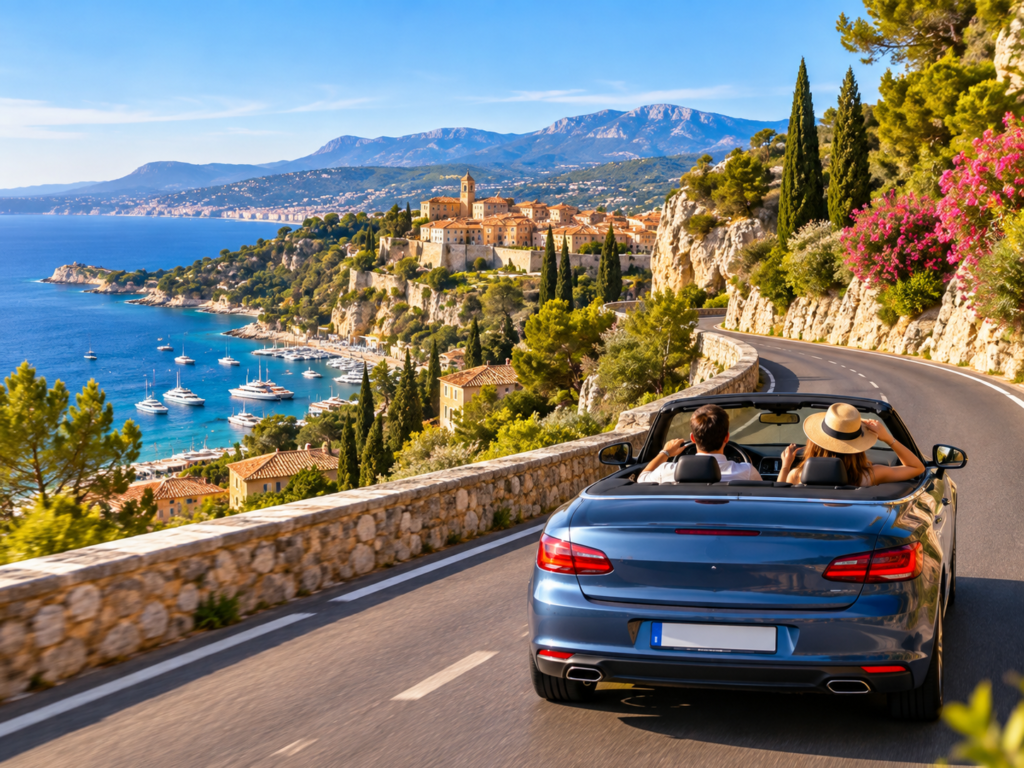
France’s geography is genuinely varied enough that different roads suit different kinds of travellers entirely. The best route depends on your travel style, available time, comfort with mountain driving, and what you actually want to feel at the end of the day.
- Route des Grandes Alpes (Lake Geneva to the Côte d’Azur): This is the mountain road trip for drivers who want the real thing, 700-plus kilometres of Alpine passes, hairpin bends, and glacial valleys linking Lake Geneva to the Mediterranean. It crosses 17 mountain passes, including the Col de l’Iseran at 2,764 m, the highest paved pass in the Alps.
- Normandy Coast Road (Rouen to Mont Saint-Michel): This route takes in one of Europe’s most emotionally layered coastlines, the chalk cliffs of Étretat, the D-Day landing beaches, the mediaeval streets of Bayeux, and the extraordinary tidal island of Mont Saint-Michel.
- Provence and the French Riviera (Avignon to Nice): The classic southern France road trip. Lavender fields, ochre-hued villages, Roman ruins, and eventually the glittering coastline of the Côte d’Azur.
- Alsace Wine Route and the Rhine Valley (Strasbourg to Colmar): France’s most intimate road trip, a gentle meander through vineyard-draped hillsides, flower-boxed medieval villages, and Gothic cathedrals in Alsace.
Best Road Trip Destinations in France
1. Route des Grandes Alpes – Lake Geneva to the Côte d’Azur
Route and Key Stops
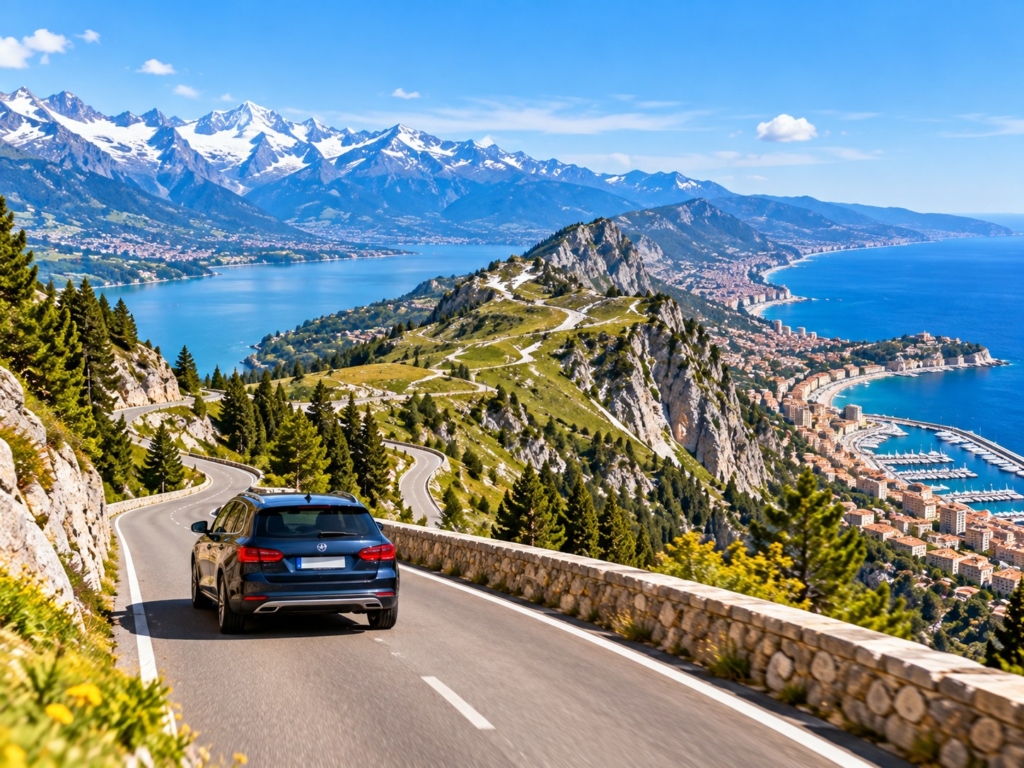
This is the one that drivers talk about the way hikers talk about completing a great trail. The Route des Grandes Alpes runs approximately 720 km from Thonon-les-Bains on Lake Geneva to Menton on the French Riviera, crossing 17 mountain passes, including six above 2,000 metres, and passing through four national parks. It was proposed in 1909, opened in stages, and fully paved by 1937. Today, the road quality ranges from excellent to occasionally challenging, exactly as it should.
The Route: Thonon-les-Bains → Bourg-Saint-Maurice → Val d’Isère → Col de l’Iseran → Briançon → Gap → Castellane → Nice.
What to Expect
The Experience: At the Col de l’Iseran (2,764 m), the highest paved pass in the Alps, you are above everything – sky, valley towns, and the sense that the world below is a separate place entirely. The Col du Galibier, a Tour de France legend, throws up panoramic views of the Écrins range and Mont Blanc on clear days. Briançon, the highest city in Europe at 1,326 m, has UNESCO-listed Vauban fortifications that deserve at least a morning. And the final descent into Nice – dropping from Alpine stone into the blue warmth of the Mediterranean – is one of the great arrivals in European driving.
Budget
- Ideal Duration: 7 to 10 Days
- Fuel: INR 7,500 to INR 12,000 (mountain terrain requires lower-gear driving; fuel consumption is high)
- Car Rental: INR 4,500 to INR 7,500 per day for a standard manual; expect higher for an automatic
- Accommodation (per night): INR 5,000 to INR 9,000 (village guesthouses and 2-star hotels in Bourg-Saint-Maurice or Briançon) | INR 14,000 to INR 30,000 (boutique mountain hotels with valley views)
- Food (per day, per person): INR 2,000 to INR 4,500 (market picnics, mountain village cafés) | INR 5,000 to INR 10,000 (hotel dinners and restaurant meals)
- Package: INR 95,000 to INR 1,80,000 per person
How to Reach the Route
Route des Grandes Alpes – Starting Point: Thonon-les-Bains (or Geneva)
- By Air
The most convenient airport is Geneva International (GVA) in Switzerland, which sits about 50 km from Thonon-les-Bains. From Paris CDG, Geneva is reachable by direct TGV train in about 3 hours 15 minutes. Alternatively, Lyon Saint-Exupéry Airport (LYS) is a reasonable option with connections into the Alps. Air India and Air France operate direct flights from Delhi to Paris CDG; from there, take a TGV to Geneva or Grenoble. - By Train
Paris Gare de Lyon connects directly to Geneva, Chambéry, and Grenoble via TGV, all of which give easy access to the Northern Alps. Book TGV tickets 2 to 3 months in advance through SNCF or the budget OUIGO platform, where fares from Paris to the Alps start as low as INR 2000 to INR 5000. - By Road
If you are already in Paris, drive south-east via the A6 Autoroute du Soleil toward Lyon, then transition to the A41 up toward Annecy and the Lake Geneva shore. The drive from Paris to Thonon-les-Bains covers approximately 570 km and takes around 5 to 6 hours without stops. French motorway tolls apply throughout; factor in roughly €40 to €60 for the Paris-to-Alps section.
Best Time to Visit
Route des Grandes Alpes: June to October is the only viable window; the Col de l’Iseran and Col du Galibier don’t open until mid-June at the earliest, and some years the timing shifts depending on winter snowfall. September is particularly good: the passes are clear, the summer holiday crowds have gone, and the Alpine light in late season has a quality that photographs well. July and August work, but the route sees its highest traffic volume, particularly from cyclists chasing the Tour de France legacy roads.
Driving Requirements
- All Nationalities: No special access permits required. The route is a public road network. However, the Col de l’Iseran, Col du Galibier, and Col du Bonette are only accessible from June to October; exact opening dates depend on snowmelt and are announced annually by the Savoie and Hautes-Alpes departments.
- Crit’Air Vignette: Required if you are entering the Nice Low Emission Zone (ZFE) at the southern end of the route. Apply online at Certificat-Air.gouv.fr at least 3 to 4 weeks before arrival; the sticker is mailed to your address.
- Speed Limits: 50 km/h in towns, 80 km/h on D-roads (most of the Alpine route), and 110 km/h on dual carriageways. Mountain passes have their own advisory limits; follow them. Radar enforcement is active on French roads.
- Mandatory Carry Items: Warning triangle, reflective safety vest (in the vehicle, not the boot), first-aid kit, and a breathalyser. These are legally required in France for all vehicles.
2. Normandy Coast Road – Rouen to Mont Saint-Michel
Route and Key Stops
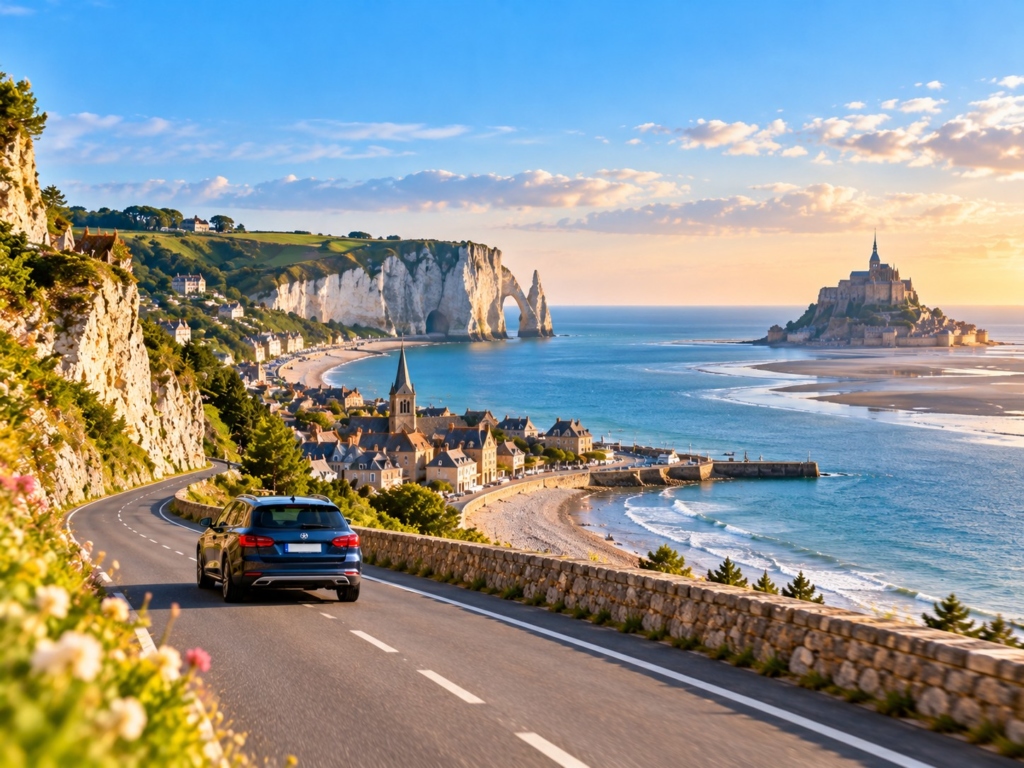
This route covers roughly 550 km of northern France’s most emotionally charged landscape half war memorial, half fairy tale, as one travel writer described it. The chalk cliffs at Étretat, the D-Day beaches, the medieval streets of Bayeux and Honfleur, and the extraordinary tidal island of Mont Saint-Michel all sit within a comfortable driving circuit from Rouen.
The Route: Rouen → Giverny → Étretat → Honfleur → Caen → Bayeux → D-Day Beaches (Omaha, Utah) → Mont-Saint-Michel.
What to Expect
The Experience: Walking Omaha Beach at low tide is the kind of experience that stays with you long after the trip ends. The scale of it, the silence, the simple white crosses of the American Cemetery above it is not a comfortable stop, and it is not meant to be. Étretat’s chalk arch formations above the sea, painted obsessively by Monet, are extraordinary. Honfleur’s slate-shingled harbour is the prettiest in Normandy. And Mont Saint-Michel, rising from its tidal bay at dawn before the tour groups arrive, is one of those genuinely extraordinary sights that photographs cannot prepare you for.
Budget
- Ideal Duration: 6 to 8 Days
- Fuel: INR 4,500 to INR 7,000 (relatively flat; approximately 550 km route)
- Car Rental: INR 4,000 to INR 7,000 per day
- Accommodation (per night): INR 5,500 to INR 8,500 (Bayeux guesthouses, coastal B&Bs) | INR 12,000 to INR 25,000 (château hotels and sea-view stays)
- Food (per day, per person): INR 1,800 to INR 4,000 (bakeries, harbour cafés, cider-route farm stops) | INR 4,500 to INR 9,000 (full restaurant meals with Norman cheeses and calvados)
- Package: INR 75,000 to INR 1,40,000 per person
How to Reach the Route
Normandy Coast Road – Starting Point: Rouen or Paris
- By Road
This is the most natural starting point for a Normandy road trip. The A13 from Paris to Rouen covers approximately 135 km and takes just over an hour with no traffic. From Rouen, the full loop to Mont Saint-Michel and back covers roughly 550 km. This is one of the most straightforward drive-out-of-Paris options in France. - By Train
Paris Saint-Lazare to Rouen by InterCity train takes around 1 hour 10 minutes, with frequent daily departures. From Rouen, pick up a rental car; several agencies operate from the city centre and train station. Alternatively, pick up a rental at Paris CDG and drive straight to Rouen or Giverny on Day 1. - By Air
Caen Carpiquet Airport (CFR) serves limited domestic routes and is useful if you want to start closer to the D-Day beaches. Most travellers fly into Paris CDG and drive into Normandy; the drive takes around 2 hours from Paris to the Norman capital of Caen.
Best Time to Visit
Normandy Coast Road: May to September is the comfortable window. Late spring (May to early June) is the recommended sweet spot: pleasant weather, long days, and none of the D-Day commemoration crowd that fills hotels in early June. July and August are warm and busy. Avoid January to March if coastal wind and rain are not your idea of scenic.
Driving Requirements
- All Nationalities: No permits required. Standard French toll roads (autoroutes) apply on the Paris to Rouen section and some coastal stretches. Tolls are payable by credit card or French toll badge; Indian debit cards work at most manned booths but not always at automated lanes.
- D-Day Beach Access: The beaches themselves – Omaha, Utah, Gold, Juno, and Sword – are public and free. The main D-Day museums (Mémorial de Caen and Musée du Débarquement) charge entry and benefit from booking, particularly in June.
- Mont Saint-Michel: Vehicle parking is no longer permitted near the island. Park at the mainland car park (fee applies) and take the free shuttle or walk the causeway. The Abbey requires timed-entry booking in advance during peak season.
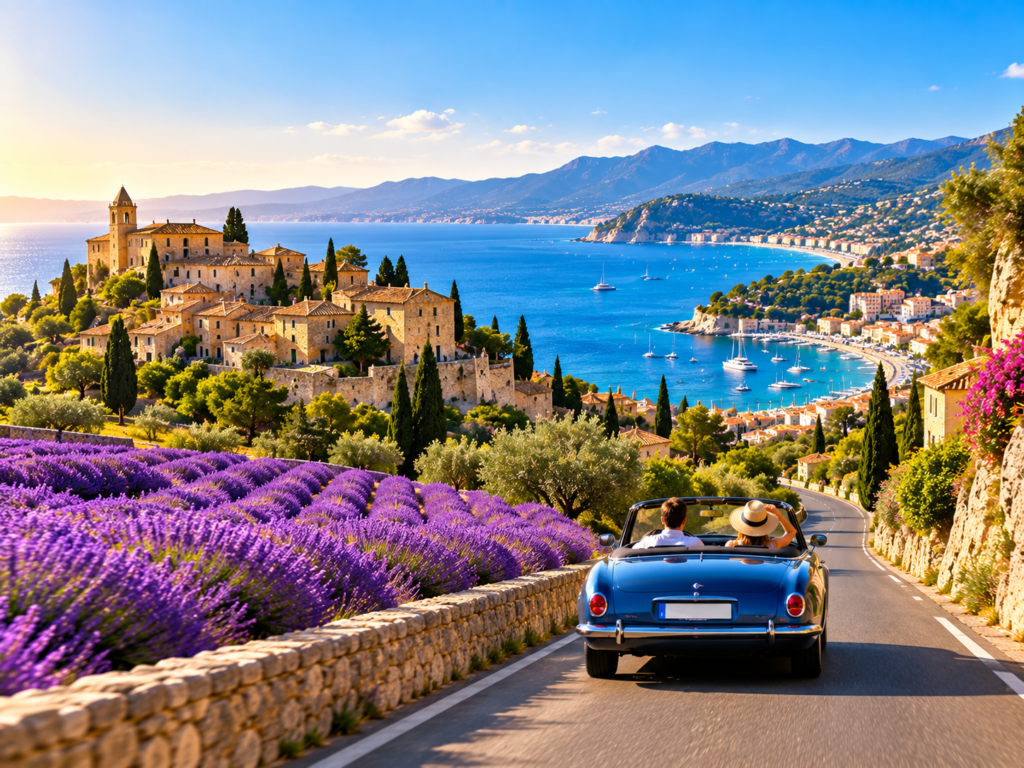
3. Provence and the French Riviera – Avignon to Nice (Lavender, Villages, and the Sea)
Route and Key Stops
This is the France that people imagine when they plan a trip to the country and the reality is, it mostly lives up to it. Approximately 417 km from Avignon to Nice, the route passes through the hill villages of the Luberon, the ochre town of Roussillon, the markets of Aix-en-Provence, the limestone canyon of the Gorges du Verdon, and eventually the Riviera coastline.
The Route: Avignon → Luberon Villages (Gordes, Roussillon) → Aix-en-Provence → Gorges du Verdon → Cannes → Nice.
What to Expect
The Experience: The Gorges du Verdon is the part of this route that surprises most travellers a canyon carved 700 metres deep by an impossibly turquoise river, with a one-way road system along its lip that forces you to concentrate on driving and then rewards you with views you were not expecting. Roussillon’s red-ochre buildings against the blue Provençal sky do not look real. Aix-en-Provence has tree-lined boulevards, café terraces on Cours Mirabeau, and the kind of relaxed morning rhythm that makes you want to stay longer than planned.
Budget
- Ideal Duration: 7 to 10 Days
- Fuel: INR 6,000 to INR 9,500 (approximately 417 km route with detours into hill villages)
- Car Rental: INR 4,000 to INR 7,500 per day
- Accommodation (per night): INR 5,000 to INR 9,000 (mas (Provençal farmhouses) and village chambres d’hôtes) | INR 14,000 to INR 35,000 (luxury hotel in Aix-en-Provence or Nice waterfront)
- Food (per day, per person): INR 2,000 to INR 4,500 (markets, rosé wine at producer prices, village boulangeries) | INR 5,500 to INR 12,000 (restaurant meals in Aix or Nice)
- Package: INR 85,000 to INR 160,000 per person
How to Reach the Route
Provence and French Riviera – Starting Point: Avignon or Paris
- By Road and TGV
The TGV from Paris Gare de Lyon to Avignon TGV takes just 2 hours 38 minutes — one of the most useful high-speed train connections in France for road trippers, who can pick up a rental car directly at Avignon TGV station and begin driving immediately. Alternatively, Paris to Avignon by motorway is approximately 700 km, taking around 6 hours via the A7 Autoroute du Soleil. The drive itself is pleasant through the Rhône Valley. - By Air
Nice Côte d’Azur Airport (NCE) is ideal for travellers who want to drive the Provence route in reverse, starting on the Riviera and finishing in Avignon. Nice is connected by direct flights from several European hubs and from India via Paris CDG with a connection.
Best Time to Visit
Provence and French Riviera: Late April to mid-June and September to mid-October consistently give the best experience: comfortable temperatures for driving and walking, manageable tourist volumes, and good value on accommodation. The lavender peaks in early to mid-July, if that is a specific objective. August is gorgeous and expensive and crowded, in that order.
Driving Requirements
Provence, Riviera, and Alsace Routes
- All Nationalities: No special permits required for any of these routes. Standard motorway tolls apply on autoroutes; the A7 Paris to Avignon section has significant toll costs. Budget approximately INR 5004 to INR 6,671one-way.
- Crit’Air Vignette: Required for entering Nice’s Low Emission Zone and several other French cities with ZFEs, including Strasbourg and Lyon. Apply well in advance.
- Gorges du Verdon: The D952 one-way traffic system applies on sections of the gorge road. Follow the direction signs; the route around the canyon is managed to avoid head-on conflicts on the narrow sections.
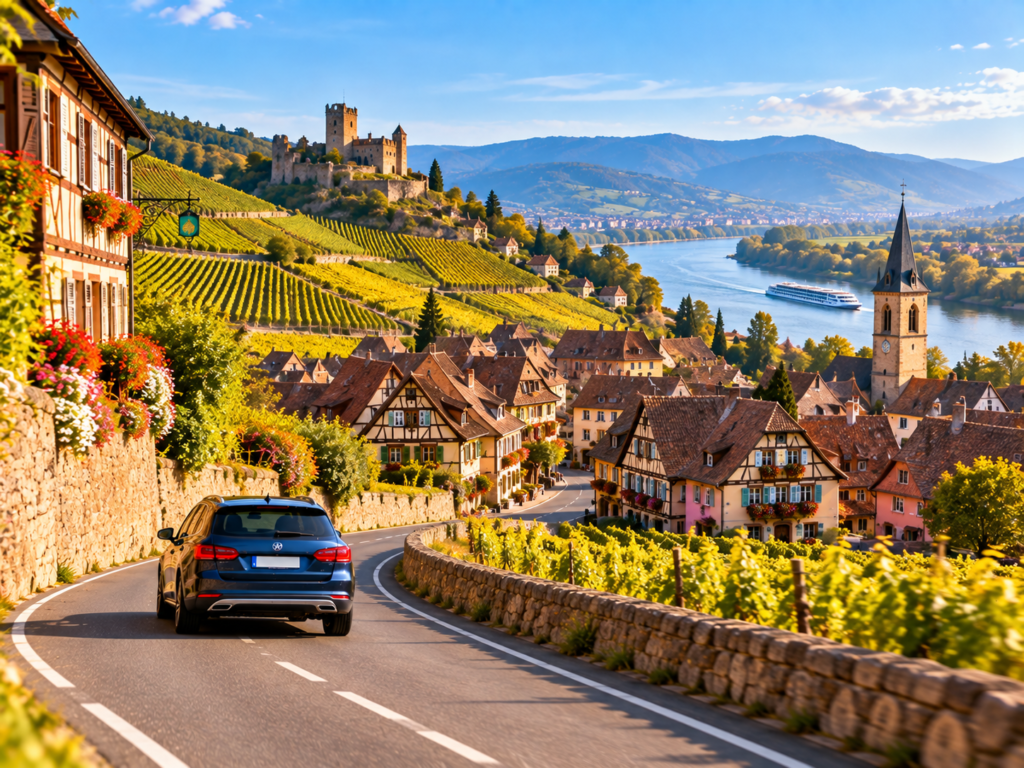
4. Alsace Wine Route and Rhine Valley – Strasbourg to Colmar (The Storybook Drive)
Route and Key Stops
This is a different kind of France road trip — intimate, gentle, and consistently beautiful in the way that makes you think the villages have been art-directed. The Route des Vins d’Alsace follows approximately 170 km along the eastern foothills of the Vosges mountains, linking mediaeval villages like Riquewihr, Kaysersberg, and Eguisheim, each with its own flower-boxed half-timbered character.
The Route: Strasbourg → Obernai → Sélestat → Ribeauvillé → Riquewihr → Kaysersberg → Colmar.
What to Expect
The Experience: Riquewihr is the one village on this route where you genuinely stop in the street and just look. The Riesling and Gewurztraminer produced in the vineyards directly bordering these villages are among the best white wines in France, and buying them directly from a producer cooperative in Riquewihr or Eguisheim, for a fraction of what they cost outside the region, is one of the quiet pleasures of this route. Strasbourg’s Cathédrale Notre-Dame, with its single asymmetric tower and rose window, is extraordinary. Colmar’s Petite Venise, canals, flower-draped merchant houses, and narrow boats are the route’s finale and genuinely live up to the photography.
Budget
- Ideal Duration: 4 to 6 Days
- Fuel: INR 2,500 to INR 4,000 (short, pleasant route of approximately 170 km)
- Car Rental: INR 4,000 to INR 6,500 per day
- Accommodation (per night): INR 4,500 to INR 8,000 (village guesthouses, wine estate B&Bs) | INR 12,000 to INR 22,000 (boutique hotels in Strasbourg or Colmar)
- Food (per day, per person): INR 1,800 to INR 3,500 (winstub meals, market tastings, choucroute plates) | INR 4,000 to INR 8,000 (wine-pairing restaurant dinners)
- Package: INR 45,000 to INR 90,000 per person
How to Reach the Route
Alsace Wine Route – Starting Point: Strasbourg
- By Air
Strasbourg Airport (SXB) has direct connections to Paris and several European cities. From India, fly into Paris CDG and connect to Strasbourg – or take the TGV direct from Paris Est to Strasbourg, which covers the 490 km journey in just 1 hour 47 minutes. The TGV from Paris to Strasbourg is one of the fastest in Europe and a genuinely comfortable start to this trip. - By Road
From Paris, the A4 heads east to Strasbourg – approximately 490 km, taking around 4 hours 30 minutes with tolls. If you are already in northern France after the Normandy route, Strasbourg makes a natural extension eastward before crossing into Germany or Switzerland.
Best Time to Visit
Alsace Wine Route: May to June for blooms and quiet roads, or September to October for harvest season and the most animated version of the villages. From late November to December for the Christmas markets, Strasbourg’s market is one of the oldest in Europe and genuinely spectacular, but book accommodation months ahead.
France Road Trip: Most Popular Among Our Travellers
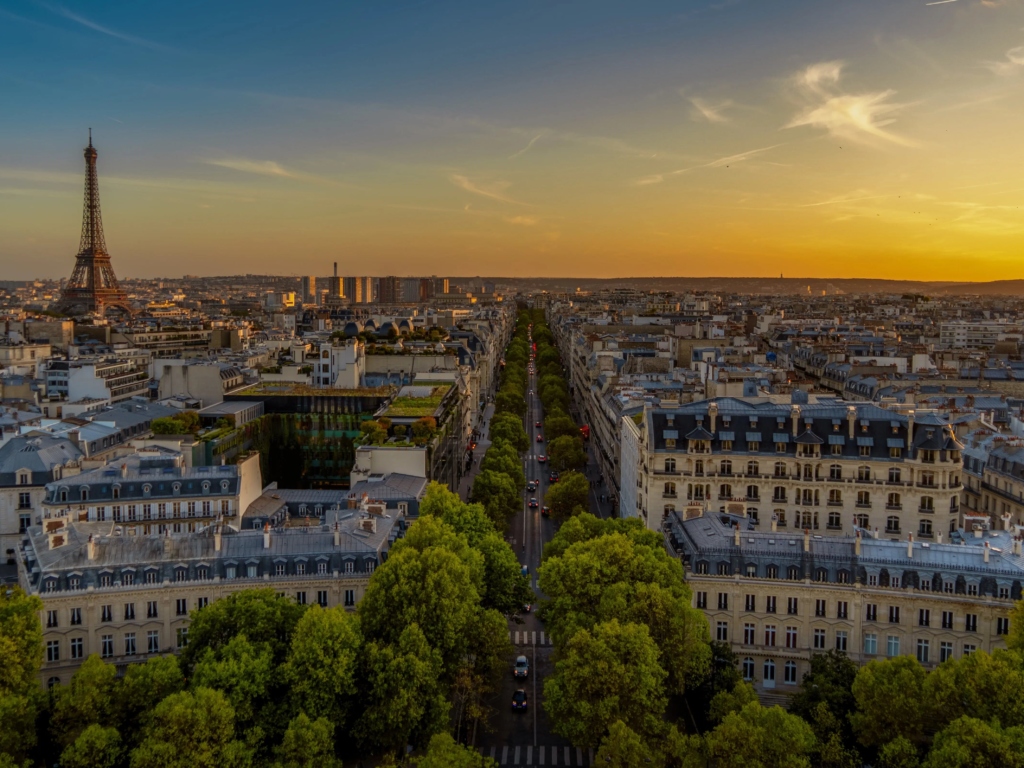
This 10-day France tour itinerary covers one of the most popular France road trip circuits: Paris to Normandy, down through the Loire Valley, and ending in Provence. It is particularly suited to first-time France road trippers who want variety – history, coastline, châteaux, and the south – without a single exhausting driving day.
10 Days, 9 Nights: Normandy, Loire Valley, and Provence
- Day 1: Paris to Giverny and Rouen. Collect the rental car at Paris CDG. Drive first to Giverny; arrive by 9 AM if possible, before tour buses fill Monet’s garden. Continue to Rouen for the evening. Walk the Gros-Horloge and the medieval streets. Dinner in a half-timbered restaurant on Rue du Gros-Horloge. Overnight: Rouen city centre.
- Day 2: Étretat and Honfleur. Drive the Alabaster Coast north to Étretat. The chalk arch formations above the sea are best in morning light. Continue west to Honfleur, the harbour, the old salt warehouses, and the narrow Rue des Hommes de Bois. Overnight: Honfleur.
- Day 3: D-Day Beaches and Bayeux. Drive west to the D-Day landing beaches. Spend time at Omaha Beach and the American Cemetery; plan two hours minimum. Continue to Bayeux, which gives easy access to the Tapestry Museum (late 11th century, genuinely astonishing in person). Overnight: Bayeux.
- Day 4: Mont Saint-Michel. Drive south to Mont Saint-Michel. Book abbey entry in advance and aim to arrive before 9 AM or after 5 PM to experience it outside peak hours. Overnight near Mont Saint-Michel or continue south toward the Loire Valley.
- Day 5: Loire Valley – Amboise and Chambord. Drive into the Loire Valley. Visit Château de Chambord in the morning, the largest château in the Loire and genuinely imposing. Continue to Amboise for the Leonardo da Vinci Museum at Clos Lucé. Overnight: Amboise or Tours.
- Day 6: Loire Valley – Chenonceau and Departure South. Morning at Château de Chenonceau, the château built spanning the River Cher, which is the most beautiful château in France by most accounts. Afternoon: begin driving south toward Provence via the A75 through the Massif Central — the Millau Viaduct crossing (the world’s tallest bridge) is worth stopping for. Overnight: Millau or Montpellier.
- Day 7: Arrival in Provence – Avignon. Drive into Avignon. Walk the Palais des Papes (Papal Palace, the largest Gothic building in Europe), cross the Pont d’Avignon, and wander the old town in the evening. Overnight: Avignon.
- Day 8: Luberon Villages. Drive into the Luberon hills. Gordes (perched stone village), Roussillon (ochre façades, Sentier des Ocres trail), and Bonnieux for lunch views. The villages are best mid-morning and after 4 PM when the tour groups thin. Overnight: Luberon area.
- Day 9: Gorges du Verdon and Aix-en-Provence. Drive to the Gorges du Verdon, the D952 one-way system means you follow the southern rim towards Moustiers-Sainte-Marie. Allow two to three hours for the Gorge drive. Continue to Aix-en-Provence for the evening. Cours Mirabeau, the market at Place Richelme, and a proper Provençal dinner. Overnight: Aix-en-Provence.
- Day 10: Aix to Nice, then departure. Final drive along the coast to Nice. Stop at the Grande Corniche, the highest of the three coastal roads between Nice and Monaco, for the views over the Mediterranean. Nice Old Port, the Promenade des Anglais, and the last café. Return the rental car at Nice airport.
Tips and Travelling Guidelines
- Valid Driver’s Licence: A photo card licence from your home country. If your licence is from outside the EU or UK, an International Driving Permit (IDP) is highly recommended or legally required.
- Proof of Ownership & Insurance: You must carry your vehicle’s original V5C logbook (if driving your own car) and an insurance certificate proving comprehensive European coverage.
- Crit’Air Clean Air Sticker: Many French cities (like Paris, Lyon, and Marseille) are Low Emission Zones (ZFE). You must purchase a Crit’Air vignette online in advance and display it on your windscreen to avoid hefty fines.
- Reflective Safety Vests: One vest for every passenger. Crucially, they must be kept inside the cabin (e.g., the glovebox or door pockets), not buried in the boot.
- Warning Triangle: Must be placed in the boot and deployed in the event of a breakdown.
- Headlight Deflectors & Identifiers: If driving a right-hand-drive car (from the UK), you must stick on beam deflectors to avoid blinding oncoming traffic, alongside a visible UK sticker on the rear.
Why Choose Thrillophilia for the Best Road Trips in France?
A France road trip is as much about the journey as the destination, but route planning, vehicle choices, toll logistics, mountain pass timings, and unexpected situations on remote roads can all become genuinely stressful without the right support. Thrillophilia handles the practical framework so the driving stays the point.
- Curated France Road Trip Experiences: Choose from some of France’s most memorable routes, the dramatic Alpine passes of the Route des Grandes Alpes, the emotionally layered Normandy coast, the lavender and limestone of Provence, or the storybook wine villages of Alsace.
- Route Guidance and Logistics: Full support with the practical side of your journey pass opening dates, toll estimates, Crit’Air vignette requirements, and realistic daily driving distances that do not leave you exhausted at the end of each day.
- Different Budget Options: French road trips can be planned across a wide range of comfort levels, from gîtes and market picnics to château hotels and Michelin restaurant reservations.
- Flexible Trip Durations: Whether you have 4 to 6 days for the Alsace Wine Route or 8 to 10 days for the Route des Grandes Alpes, routes can be matched to your available time.
- Support for Challenging Routes: Alpine routes in particular involve high-altitude terrain, weather-dependent pass access, and limited service infrastructure. Planning with proper guidance makes these routes manageable rather than stressful.
- 24/7 On-Ground Assistance: Support throughout the trip for anything that comes up particularly useful on mountain routes where connectivity and logistical resources are thin.
- Multiple Travel Styles: Adventure driving on Alpine passes, history and coastline in Normandy, food and landscape in Provence, or wine and village life in Alsace every style of road trip has its France route.
Frequently Asked Questions
A medium- to large hatchback or compact SUV with a good power-to-weight ratio works well on this route. The passes themselves are paved and manageable in most standard rental cars, but low ground clearance is not a concern here the way it is on Indian mountain routes. What matters more is power for sustained climbing at altitude and confident handling on hairpin bends. Automatic transmission is strongly recommended for those not comfortable with manual gear management on steep inclines. Avoid small-engine city cars – they struggle at altitude and in heat.
The Route des Grandes Alpes is genuinely one of the great European motorcycle routes. The combination of smooth tarmac, dramatic switchbacks, and long open descents makes it popular with experienced riders from across Europe. Riders should be comfortable with sustained mountain riding, the route is not suitable for beginners or those unfamiliar with altitude effects on engine performance. Full weather gear is essential, as mountain conditions can change rapidly even in July and August.
Fuel stations in high Alpine villages are sparse and may not be open on Sundays or outside the summer season. The key discipline is filling up completely in valley towns before climbing to the high passes. Bourg-Saint-Maurice and Briançon are the main fuelling points on the route. Between Val d’Isère and Briançon there is an extended stretch with no reliable fuel availability do not attempt this section with less than three-quarters of a tank. Unlike the Tandi to Karu stretch on the Manali-Leh highway, there is no 365 km dry run, but the mountain timing of fuel stops still matters.
No special driving permits are required beyond your Indian driving licence plus an International Driving Permit (IDP); the latter is strongly recommended and required by most rental car companies in France. Apply for the IDP from the AAI (Automobile Association of India) before your departure. Crit’Air vignettes are required if entering low emission zones in Nice, Strasbourg, Lyon, and several other French cities. Apply online at least 3 to 4 weeks before travel. Motorway tolls (péage) apply on autoroutes; most now accept Visa and Mastercard at automated lanes.
The answer depends entirely on the route. The Route des Grandes Alpes is only fully possible June to October due to pass closures from snow. Normandy and the Alsace Wine Route are pleasant from May to October. Provence peaks in May to June and September to October. The consistent truth across all French road trips is that the shoulder seasons late April to early June, and September to mid-October give the best combination of weather, manageable crowds, and reasonable prices.
France has one of the most varied accommodation ecosystems in Europe for road trippers. Chambres d’hôtes (family-run B&Bs) are the most characterful option across rural Normandy, Provence, and Alsace – often in converted farmhouses or wine estates, and usually including breakfast. Gîtes (self-catering properties) make economic sense for groups or longer stays. Along the Alpine route, valley-town hotels in Bourg-Saint-Maurice and Briançon offer reliable comfort. Book ahead for any summer travel – France’s internal holiday demand is high and rural accommodation books quickly, particularly in July and August.
Coverage is good throughout Normandy, Provence, and Alsace. The Route des Grandes Alpes has patchy coverage in high passes and remote valleys — download offline maps before each day’s drive and do not rely on real-time navigation in the highest sections. Orange and SFR have the widest rural coverage in France. A French SIM or European roaming plan is the simplest solution for Indian travellers on a 30-day or longer trip. The situation is incomparably better than the Manali-Leh or Spiti routes in India, but the high Alpine sections do have genuine dead zones.
France is broadly card-accepting, and contactless payment works at most petrol stations, restaurants, and tourist sites. The exceptions are some rural markets, small village fromageries, and farm-gate wine producers who prefer cash. Automated motorway toll lanes accept Visa and Mastercard but not always non-European bank debit cards, keep a small cash reserve for tolls if your card has issues. For convenience, carry €100 to €150 in cash and supplement with a card that does not charge foreign transaction fees.
The packing list varies significantly by route. For the Route des Grandes Alpes, pack exactly as you would for a mountain trip, layers, a windproof fleece, and a waterproof outer layer are essential even in July. Mountain passes above 2,000 m experience cold and wind regardless of the valley temperature below. UV-protection sunglasses are necessary at altitude. For Normandy and Alsace in spring or autumn, a waterproof layer is the main practical addition to standard European travel clothing. Provence in summer needs sun protection above everything else – UV levels in southern France are high.
France drives on the right. Speed limits are 50 km/h in towns, 80 km/h on undivided D-roads (which cover most scenic routes), 110 km/h on dual carriageways, and 130 km/h on motorways. A 0.05% blood alcohol limit applies. French law requires every vehicle to carry a warning triangle, a reflective safety vest (accessible from inside the car, not in the boot), and a breathalyser kit. Radar enforcement is active, and France uses both fixed and mobile speed cameras extensively. Priorité à droite giving way to traffic from the right at unmarked junctions – still applies in villages and residential streets and catches unfamiliar drivers off-guard.