


Quick Jumplinks to Navigate
Let’s begin by answering the most common query of people travelling to Bhutan: “Does UPI work in Bhutan for Indian tourists?”
Well, Yes. UPI is accepted at participating merchants in Bhutan through the country’s national QR payment system. The Embassy of India in Thimphu has confirmed the cross-border UPI payment arrangement, making it useful to check official guidance alongside your payment app’s instructions before departure.
Indian visitors can use supported UPI apps, including BHIM, PhonePe, Paytm and Google Pay, at participating establishments. The Embassy of India in Thimphu confirms this arrangement.
However, UPI acceptance does not mean that every shop, taxi, restaurant or market stall in Bhutan will accept digital payments.
Before travelling, understand how UPI, cash, cards, ATMs and local mobile networks work so you can avoid payment problems during your Bhutan trip.
1. Activate international payments before using UPI in Bhutan
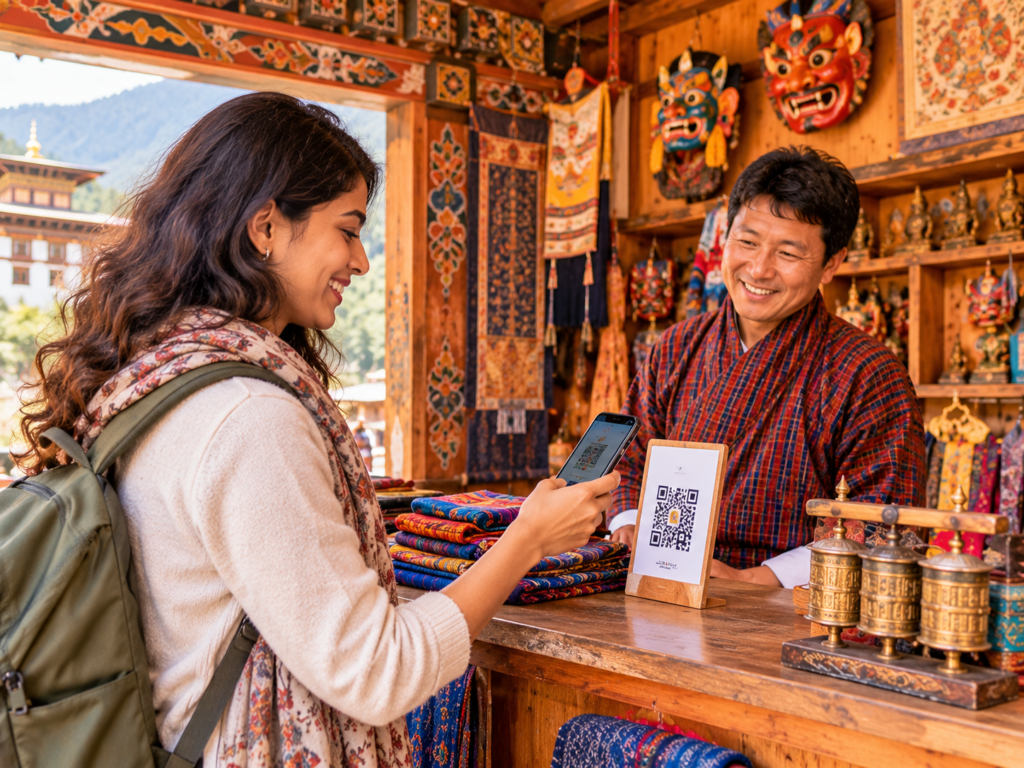
If you plan to use UPI in Bhutan, prepare your payment app before leaving India.
- Check that your UPI app and linked bank account are active.
- Check whether your bank or payment app requires international UPI payments to be enabled.
- Ensure your registered mobile number can receive any required authentication messages.
- Keep your app updated and remember your security credentials.
- Carry another payment method in case a QR code is unsupported or a transaction fails.
Bhutan National Bank and Bhutan Development Bank both describe UPI payments through eligible Indian banking apps at their supported QR terminals.
Do not assume that a successful UPI payment in India guarantees acceptance at every Bhutanese merchant. Look for a supported merchant QR code and check the payment confirmation before leaving.
2. Can you use Google Pay, PhonePe and Paytm in Bhutan?
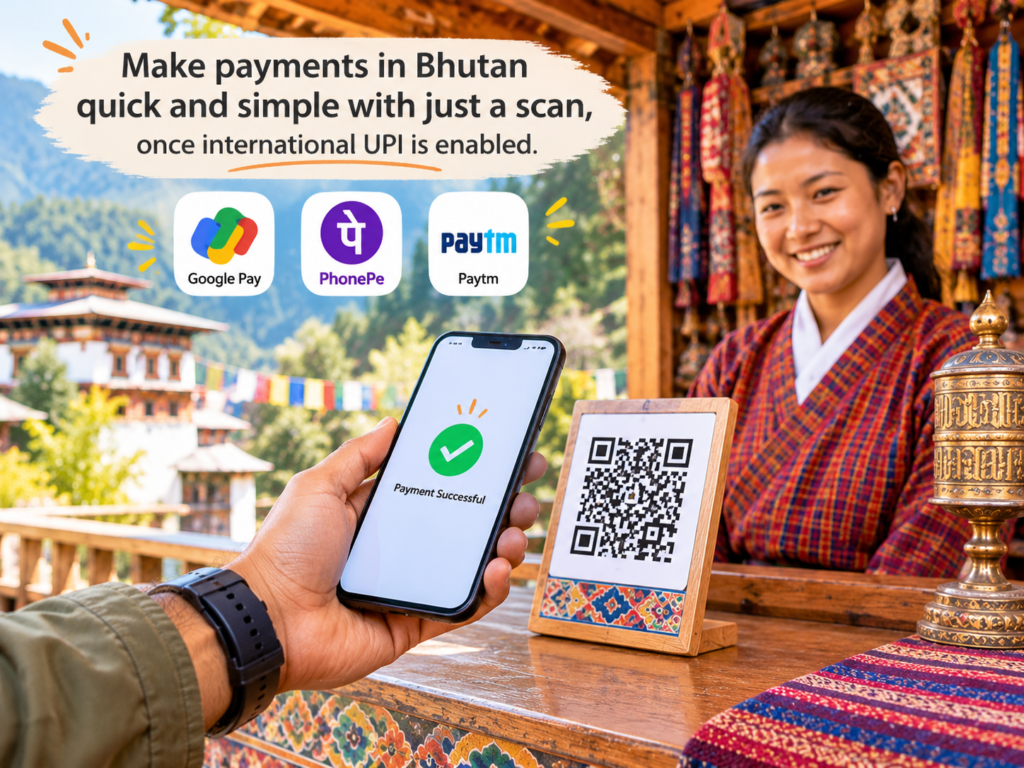
Yes, these apps can be used at participating merchants when the international UPI payment facility and merchant QR system support the transaction.
The important distinction is between paying a merchant and sending money to another person. Cross-border merchant QR acceptance does not automatically mean that every person-to-person transfer, bank transfer or domestic payment feature will work abroad.
For a smoother experience:
- Open your usual payment app before the trip and check its international payment instructions.
- Keep your bank’s customer support details handy.
- Review the amount and currency displayed before confirming.
- Check your bank statement or transaction history if a payment appears unsuccessful.
- Avoid repeatedly retrying a transaction until you know whether the first attempt was debited.
Also check your bank’s current fees, exchange-rate treatment and transaction limits. These may depend on the payment provider and can change.
3. Should Indians carry cash to Bhutan even if UPI works?
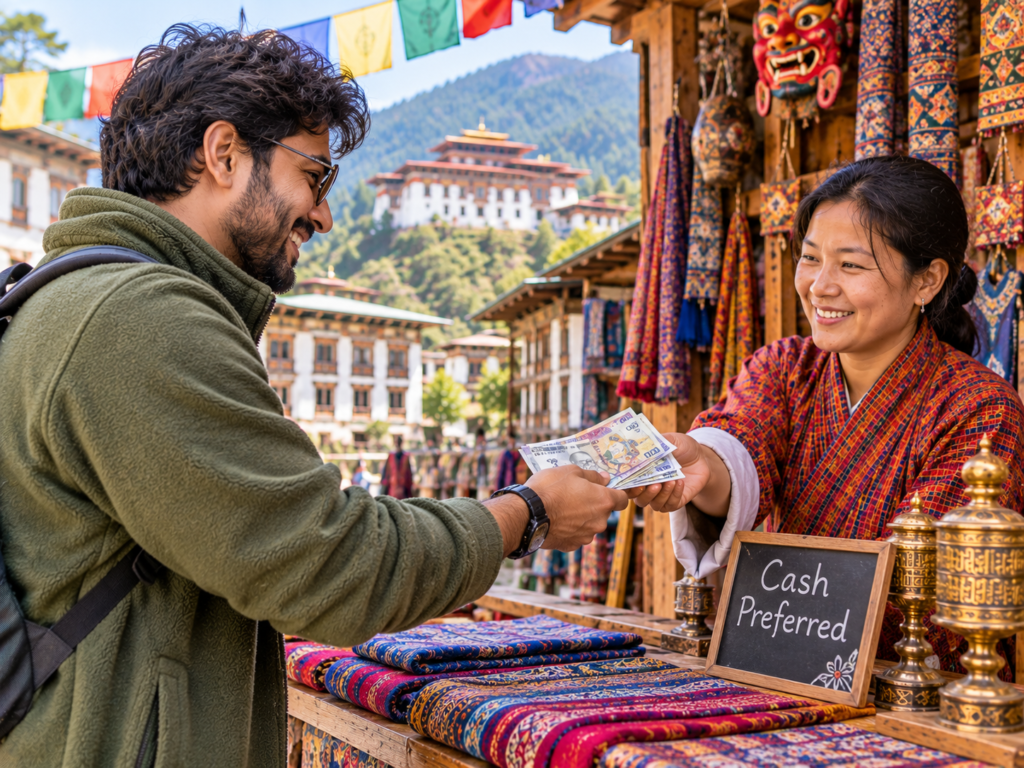
Absolutely. Cash remains important because UPI is not universally accepted, particularly at smaller businesses, remote stops and some transport providers.
For itineraries that include smaller towns and remote sightseeing stops, carrying backup cash is a practical precaution because access to payment terminals and reliable mobile connectivity can vary by location.
Carry a reasonable amount of cash for daily purchases and unexpected expenses. You can use it for situations such as:
- Buying snacks or souvenirs from small vendors.
- Paying at establishments without QR payment facilities.
- Making small purchases when mobile connectivity is weak.
- Covering transport or other expenses when digital payment is unavailable.
- Handling emergencies if your phone battery runs out.
Keep cash divided between a secure wallet and a separate backup location. If you are on a family trip to Bhutan, it’s better for everyone to carry some cash.
4. Can Indians use Indian rupees in Bhutan?
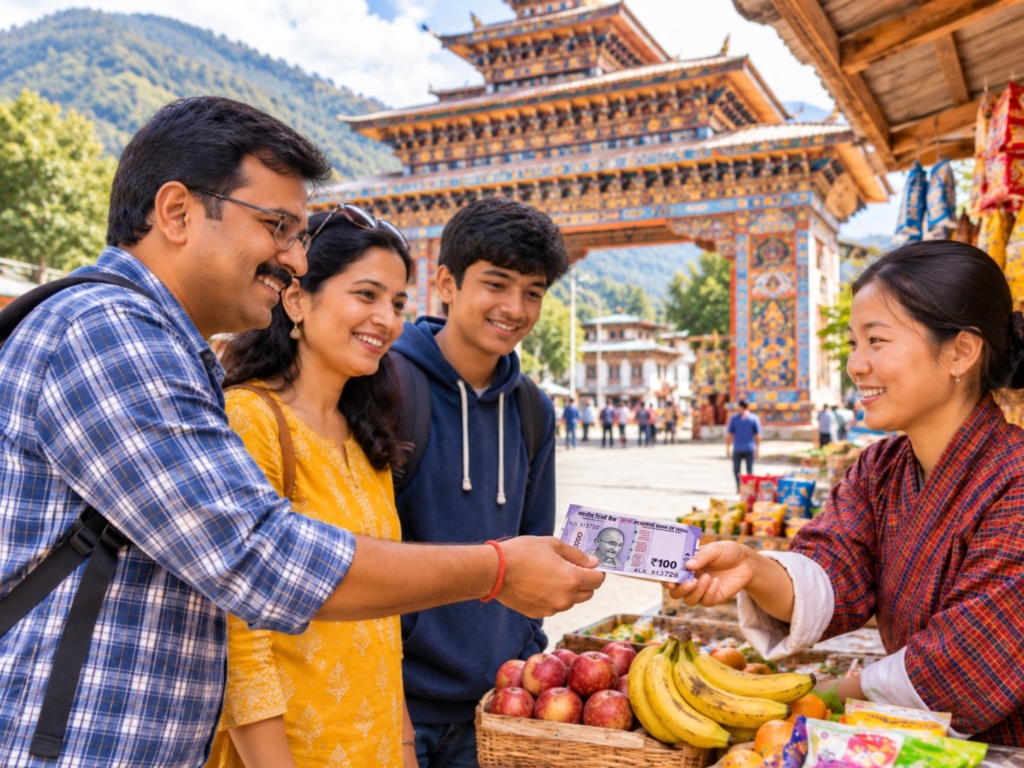
Yes. Indian rupees are accepted for many payments in Bhutan, alongside the Bhutanese ngultrum (Nu.), but acceptance can vary by business and transaction.
The ngultrum is Bhutan’s local currency, and its value is pegged at par with the Indian rupee. Nevertheless, do not assume every Indian denomination will be accepted everywhere or that every merchant will provide change in your preferred currency.
For practical purposes:
- Carry smaller Indian rupee notes for routine purchases.
- Ask whether a merchant accepts Indian rupees before ordering or buying.
- Check the currency and amount when receiving change.
- Avoid relying entirely on cash in Indian rupees for the entire trip.
- Keep some backup funds available through another supported payment method.
5. Can you use debit and credit cards in Bhutan?
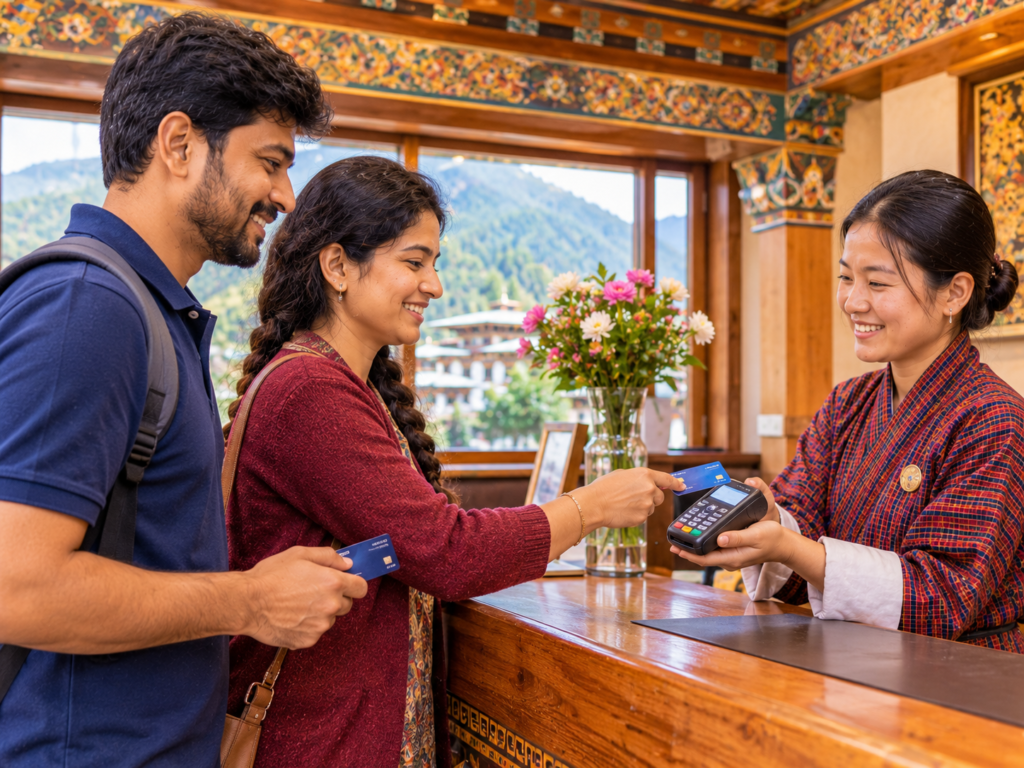
Cards can be useful for hotel bills, larger purchases and payments at establishments with compatible terminals.
Bhutan National Bank lists Visa, RuPay and several other card networks among its supported card services, with acceptance depending on the relevant terminal and transaction.
Before travelling, check whether your card is enabled for international transactions and whether your issuer charges foreign transaction fees.
A few precautions:
- Carry a second card if available.
- Keep your card PIN accessible to you but secure.
- Check international transaction settings with your bank.
- Ask whether the merchant’s terminal supports your particular card.
- Review the final amount before authorising the payment.
6. Can Indians withdraw money from ATMs in Bhutan?
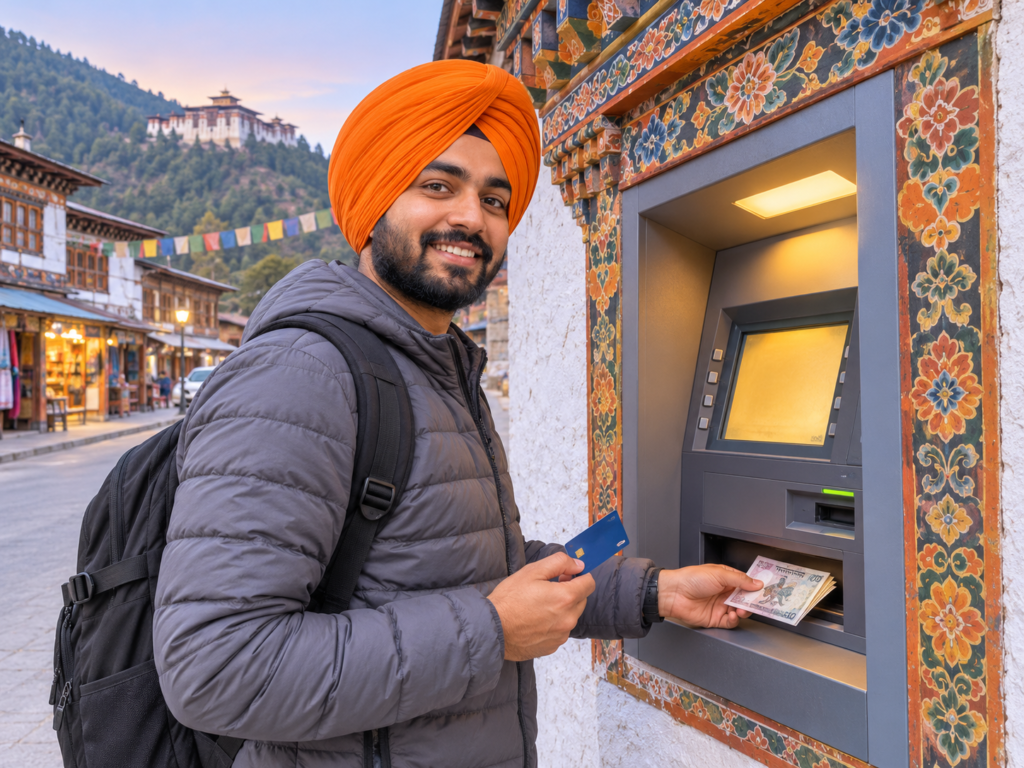
Yes, eligible cards can be used at supported ATMs, subject to the card network, issuing bank and ATM operator.
Bhutan National Bank publishes tourist card guidance that includes ATM withdrawals and applicable fees. Its listed services and charges can change, so check the latest information before relying on them.
Thrillophilia’s destination experts suggest that if you’re covering several towns, it is better to withdraw or arrange sufficient cash before leaving a larger centre.
If you plan to withdraw cash:
- Confirm international ATM access with your Indian bank.
- Check withdrawal fees and your daily cash limit.
- Prefer ATMs in established commercial areas or bank premises.
- Keep the withdrawal receipt until you have checked the amount.
- Avoid waiting until you reach a remote area to look for an ATM.
7. Which SIM card should Indians buy in Bhutan?
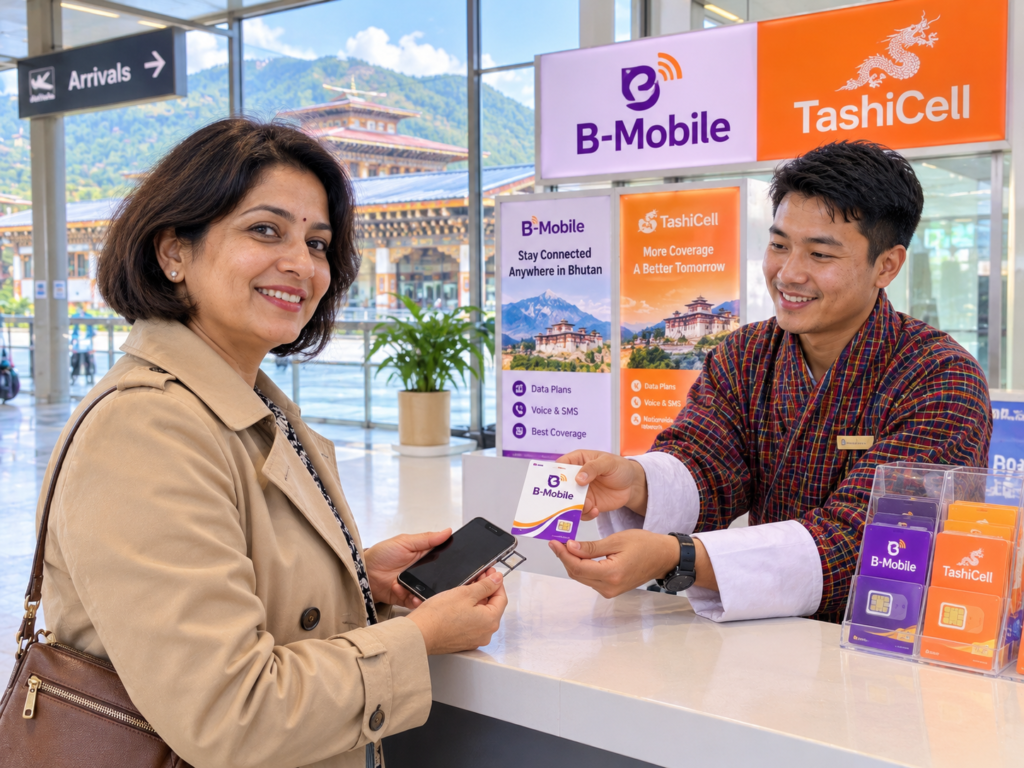
Bhutan’s two major mobile operators include Bhutan Telecom and TashiCell. Both offer tourist SIM options, with packages varying by data allowance, validity and price.
For example, Bhutan Telecom’s published tourist offers include limited-data packages and higher-priced options with larger or unlimited data allowances. TashiCell also lists tourist plans for short and longer stays. Check the operators’ current offers before purchasing because prices and benefits can change.
Choose based on how you intend to use your phone:
- For maps and occasional messages: A smaller data package may be sufficient.
- For frequent navigation and video calls: Consider a larger allowance, subject to the operator’s fair-use conditions.
- For longer trips: Compare the validity period as well as the advertised data amount.
- For business or urgent communication: Check voice-call allowances and coverage along your itinerary.
Bhutan Telecom and TashiCell offer different tourist plans, so compare the current data allowance, validity, and coverage along your planned route instead of choosing solely by the advertised data volume.
8. Can you buy a Bhutan SIM card at Paro Airport?
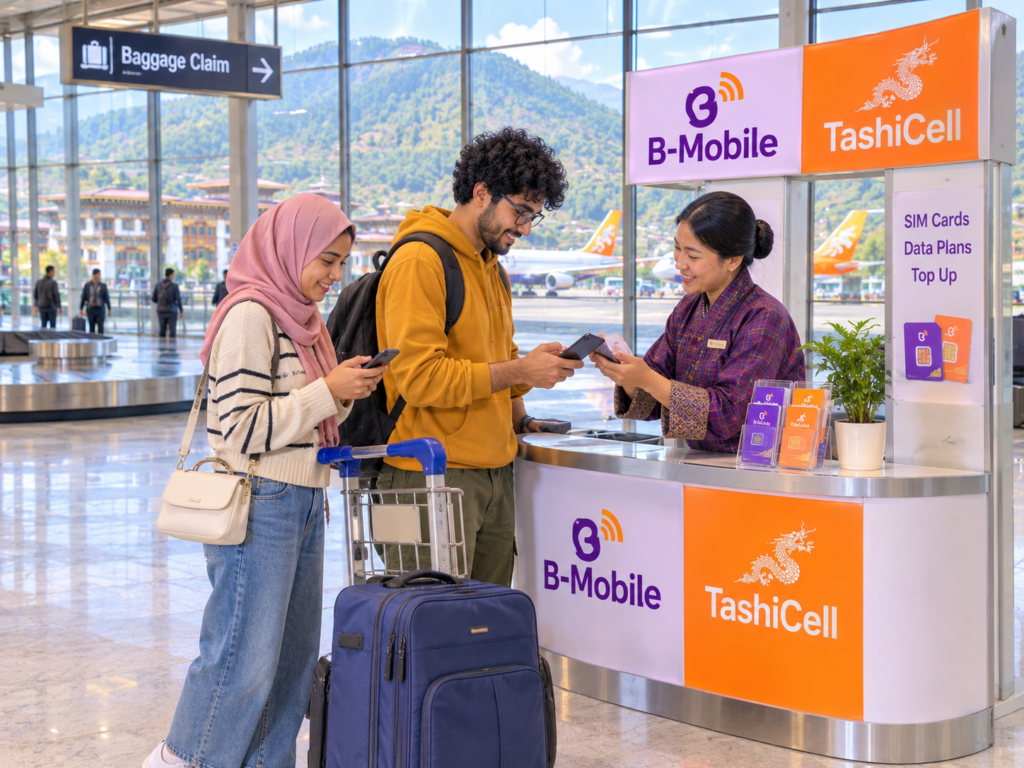
Yes. The official Paro International Airport website lists Bhutan Telecom and TashiCell tourist SIM counters in the arrivals building.
Buying a SIM at the airport can be convenient because you can arrange connectivity shortly after arrival.
Before purchasing, confirm the following:
- Your phone is unlocked and compatible with the local network.
- The package provides enough data for the length of your stay.
- The SIM or eSIM is activated successfully.
- You have the required identification documents.
- You understand when the data allowance and SIM validity expire.
9. Should you use an Indian SIM, a local SIM or an eSIM?
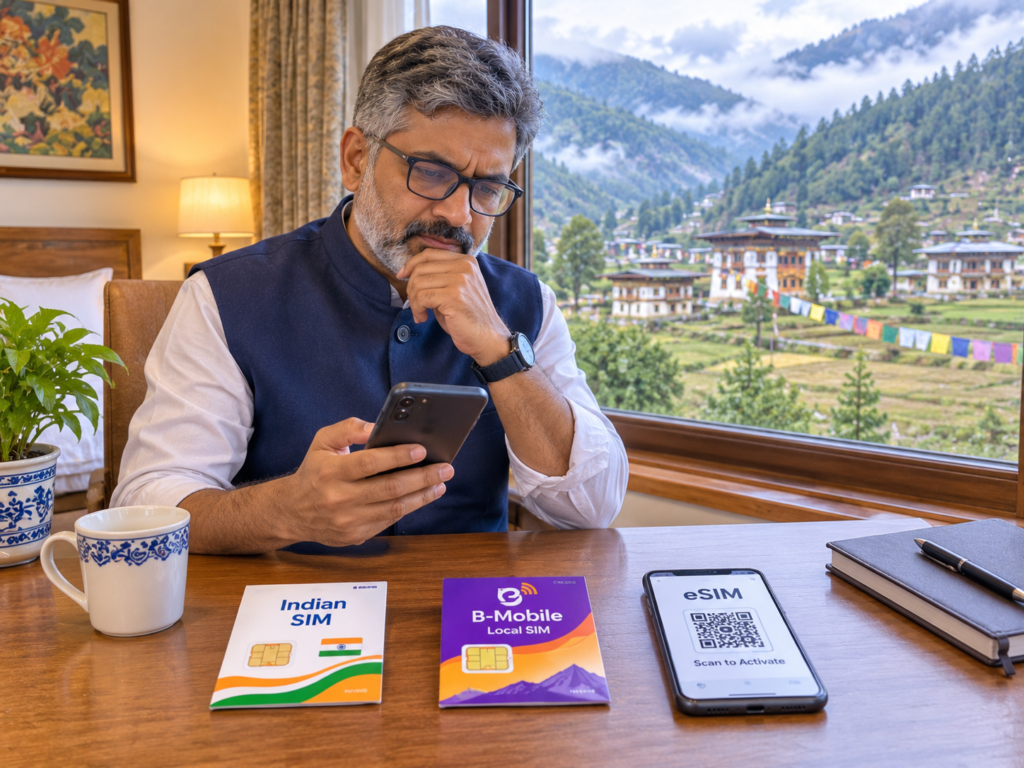
The right option depends on your phone, itinerary and need to stay connected. If you use an Indian number for banking authentication, confirm that you can still receive required messages while travelling.
- Indian SIM with international roaming: Convenient if you need to retain your regular number for calls and messages. Check your operator’s Bhutan roaming rates and plan validity.
- Local Bhutan SIM: Useful for local data and calls, with packages offered by the country’s mobile operators.
- Tourist eSIM: Convenient for compatible devices, but check the plan’s network, coverage, validity and activation requirements before purchase.
- Pocket Wi-Fi: May suit families sharing connectivity across several devices, although availability, rental conditions and coverage should be checked.
10. What is the easiest payment setup for a Bhutan trip from India?
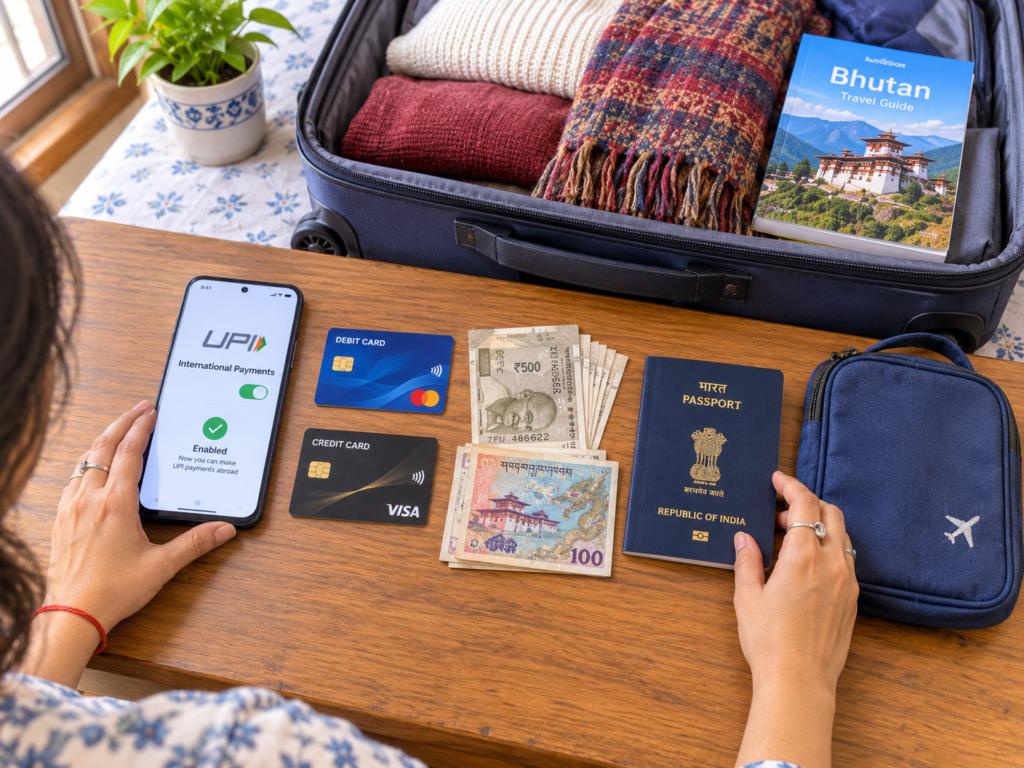
For most Indian travellers, a combination of payment methods is more practical than relying on one.
- Keep a working UPI app for participating merchants.
- Carry cash in Indian rupees and, where useful, local currency.
- Bring a debit or credit card that supports international transactions.
- Understand your ATM access and withdrawal fees.
- Arrange a local SIM, roaming plan or eSIM for navigation and communication.
- Keep a backup payment method separate from your main wallet.
Frequently Asked Questions
Do not assume every transaction is free. Merchant-side QR fees and customer-facing charges are not necessarily the same. Check your bank or app’s current terms before paying.
No. Indian rupees are accepted for many transactions, but acceptance and change availability vary. Carry a backup payment method and check before making a purchase.