

Quick Jumplinks to Navigate
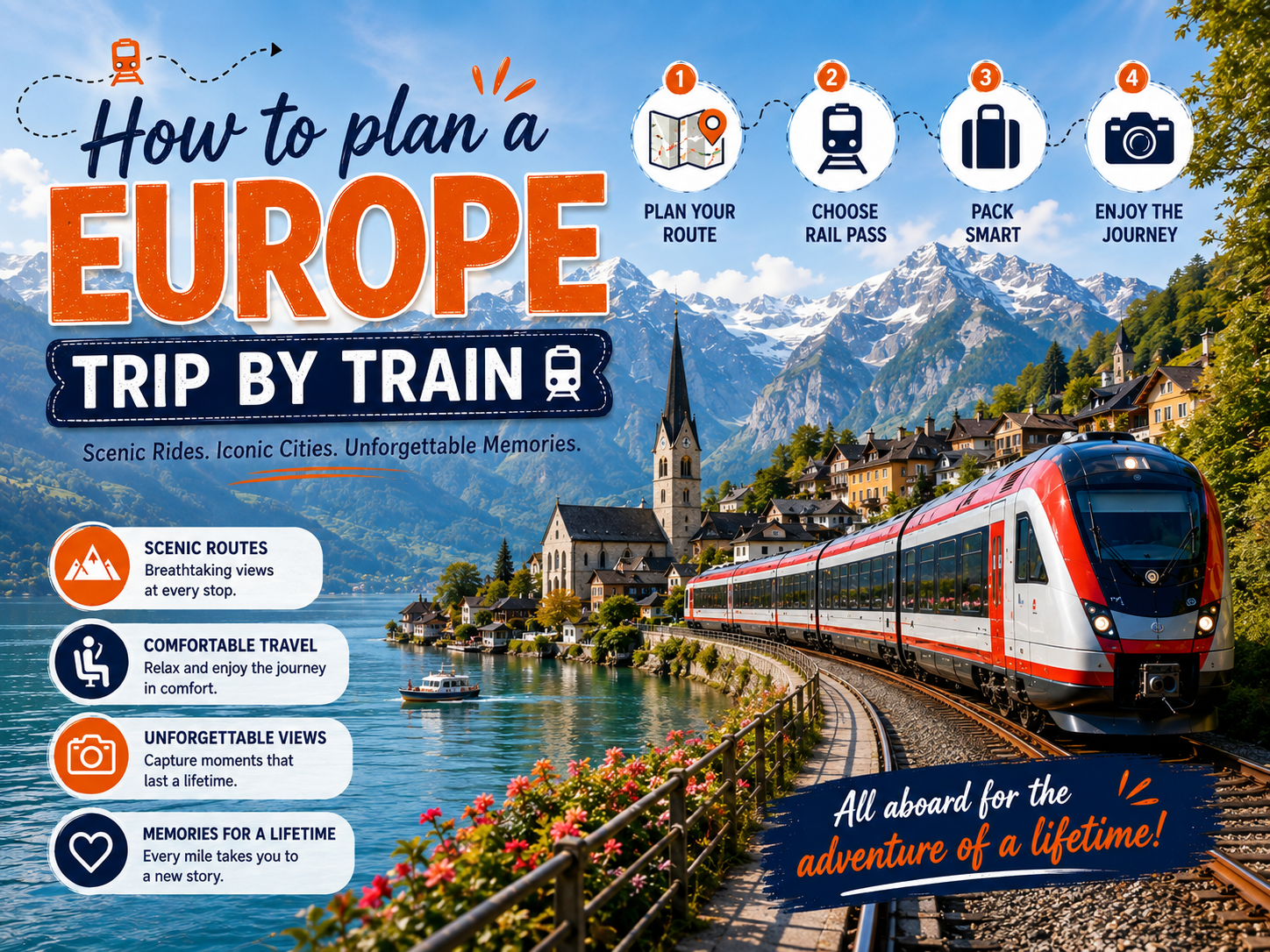
A Europe trip by train gives you a chance to see more of the continent without spending every other day at an airport. Trains connect many major cities directly, while some routes turn the journey itself into part of the experience. If you’re figuring out how to plan Europe trip by train, the first step is choosing a route that works with your time, budget and the places you genuinely want to explore.
From there, the planning becomes more practical. You need to decide between individual train tickets and rail passes, check which journeys require reservations, choose accommodation that works with your route and leave enough time between connections. A well-planned rail itinerary should help you spend more time exploring and less time rushing between stations.
For Indian travellers, this can also be a useful way to structure a multi-country Europe holiday without trying to fit too many destinations into one trip. And if coordinating the trains, stays, transfers and sightseeing feels like too much, a structured itinerary can simplify the process. Thrillophilia’s Europe tour packages, where applicable, bring these elements together with route planning, intercity transportation, sightseeing and on-ground assistance, while still leaving room to experience each destination at your own pace.
A Step-by-Step Guide to Plan a Europe Trip by Train
Start with your destinations, number of days and preferred route before looking at train tickets. A good rail itinerary should connect cities geographically instead of making you repeatedly cross the continent.
For a 10–12 day Europe holiday, for example, a route covering Paris, Zurich, Lucerne and Milan is more practical by train than trying to add Amsterdam, Prague and Rome to the same trip.
A simple planning sequence is:
- Decide which countries and cities you want to visit.
- Check the train journey between each destination.
- Compare point-to-point tickets with a rail pass.
- Check whether your trains require seat reservations.
- Leave enough time for station transfers and delays.
- Book accommodation close to convenient stations or public transport.
- Keep some flexible time rather than filling every day with travel.
Eurail’s own planning guide recommends starting with your destinations, mapping the route and then checking the trains available for each leg. Its current network covers rail travel across 33 European countries.
Choose a Europe train route that matches your itinerary
Not every European destination needs to be connected by train simply because a railway exists. The most useful routes are usually those where rail saves time compared with flying once airport transfers, security and check-in are considered.
Some popular combinations that work well for rail-based holidays include:
| Route | Why it works |
| Paris – Brussels – Amsterdam | Short international connections with major cities |
| Paris – Zurich – Lucerne – Milan | Combines cities with Alpine scenery |
| Rome – Florence – Venice | Convenient Italian high-speed rail route |
| Vienna – Budapest – Prague | Well-connected Central European cities |
| Munich – Innsbruck – Zurich | Good option for combining cities and mountain regions |
You don’t need to follow these routes exactly. The important thing is to look at the rail journey time between destinations before finalising your itinerary.
A two-hour train journey between cities can be part of the experience. A seven-hour connection every other day can start eating into the holiday itself.
Eurail Pass vs Individual Train Tickets
This is one of the biggest decisions when planning a Europe trip by train.
A Eurail Pass can make sense if you’re travelling across multiple countries and expect to take several train journeys during your trip. Eurail currently offers Global Passes covering 33 countries, as well as One Country Passes for travellers focusing on a single country.
Individual or point-to-point tickets may work better if your itinerary has only a few train journeys, particularly when you know your exact route and can book tickets at favourable fares.
A simple way to compare them is the following:
| Choose a rail pass when | Consider individual tickets when |
| You’re covering several countries | You’re visiting one or two countries |
| You expect multiple train journeys | You have only a few long-distance journeys |
| You want more flexibility | Your dates and trains are already fixed |
| You may add destinations | Your route is straightforward |
It is recommended not to assume a rail pass is automatically cheaper. Calculate the train journeys you actually expect to take, then compare their total with the cost of the relevant pass and any reservation fees.
Check Train Reservation Requirements in Europe
A common mistake is assuming that buying a Eurail Pass means you can simply board every train.
Some European trains require separate seat reservations, particularly many high-speed services and night trains. These reservations are not included in the standard Eurail Pass, so they need to be factored into your rail budget.
Before finalising your route, check:
- Whether a reservation is mandatory
- How much the reservation costs
- How far in advance it can be booked
- Whether the train has limited pass-holder seats
- Whether a slower train can avoid the reservation
Eurail states that reservations are required on most high-speed trains and all night trains, while many other trains allow pass holders to travel without one
This matters particularly during busy travel periods. If your itinerary is fixed, checking reservations before buying the pass can save you from discovering later that the train you wanted has limited availability.
How Much Does a Europe Trip by Train Cost?
Your Europe train trip cost depends on the countries covered, number of journeys, travel dates, train type and whether you use individual tickets or a rail pass.
Your rail budget can include:
- Long-distance and international train tickets
- Seat reservation fees
- Local trains and regional transport
- Airport-to-city transfers
- Metro, tram or bus travel within cities
- Luggage-related costs, where applicable
High-speed trains can be more expensive, but they can also save several hours compared with slower services. On the other hand, regional trains may offer a cheaper and more scenic alternative on certain routes.
The best approach is to compare total journey time and total cost, rather than looking only at the ticket price.
Plan Your Accommodation Around Train Stations
A railway-based holiday involves more than choosing the right train. Where you stay can also make a noticeable difference to how smoothly the trip runs.
Look for accommodation that is:
- Within a reasonable distance of the main railway station
- Well connected to local public transport
- Convenient for the attractions you plan to visit
- Practical for arriving with luggage
This becomes particularly useful when you have an early morning train or arrive in a new city after several hours of travel.
You don’t necessarily need to stay right outside the station. A well-connected neighbourhood a few metro stops away can offer better accommodation while keeping your daily travel manageable.
Add Scenic Rail Journeys to your Europe Itinerary
One of the best reasons to travel through Europe by train is that the journey itself can become part of the holiday.
Switzerland is an obvious example, with routes passing through Alpine landscapes, lakes and mountain towns. Other European routes can take you through vineyards, countryside and historic towns that you might otherwise see only from an airport window.
This is also where itinerary planning becomes more interesting. You can choose a slightly slower scenic route when the journey offers something worth experiencing, rather than treating every train purely as transportation.
At the same time, don’t turn every journey into a sightseeing expedition. If you’ve already spent several hours travelling, a faster train may be the better choice on the next leg.
Planning Transfers between European Trains
European train journeys are generally easy to navigate, but your itinerary should still leave some breathing room.
Avoid planning extremely tight connections when you’re travelling with luggage, especially if you need to change platforms or stations. A 15-minute connection might look perfectly reasonable on a timetable and feel very different when you’re unfamiliar with the station.
For international journeys, allow extra time if the route involves multiple connections. Also download your tickets, reservations and accommodation details before leaving so you aren’t dependent on mobile connectivity at every station.
A useful rule is simple: if missing one train would disrupt the rest of your itinerary, the connection probably deserves more buffer time.
How Thrillophilia Plans Europe Train Trips
A train-based Europe itinerary can be rewarding, but putting together every rail connection, hotel, transfer and sightseeing booking takes time. This is where a tour operator with destination-level experience can add value without taking away the freedom of travelling by train.
Thrillophilia’s Europe tour packages include rail-based itineraries where applicable, with the route and major logistics planned together. Depending on the package, this can include:
- Intercity transportation planned around the overall route
- Accommodation and airport transfers selected to fit the itinerary
- Sightseeing and experiences built around the time available
- 24/7 on-ground assistance during the trip
The planning goes beyond simply connecting two cities. Thrillophilia’s Europe operations team considers which cities to connect, how much travel time to allow and where a train journey genuinely adds value. Traveller feedback, destination data and on-ground experience also help refine routes across different seasons.
This leaves room for more than the standard sightseeing circuit. Depending on the itinerary, you can combine iconic attractions with scenic train journeys, local experiences and less-obvious stops, while keeping the overall route and trip cost manageable.
So you don’t necessarily have to choose between planning every rail connection yourself and joining a rigid group tour. A thoughtfully designed Thrillophilia itinerary can handle the complicated logistics while giving you the freedom to experience Europe by rail at a comfortable pace.
FAQs
For short and medium-distance journeys between well-connected European cities, trains can be more convenient because they usually take you directly between city centres. Flights can make more sense for longer distances where rail travel would take considerably more time.
A Eurail Pass can be worthwhile when your itinerary involves multiple countries and several train journeys. If you have only a few fixed journeys, individual tickets may offer better value, so compare both options before booking.
Sometimes. Many high-speed trains and all night trains require separate reservations, while many regional services do not. Reservation requirements and fees vary by route and train type.
There is no fixed number, but 2–4 countries in around 10–15 days is generally more manageable than trying to cross half of Europe. The right number depends on how much time you want to spend travelling versus exploring.
Yes. Thrillophilia offers Europe itineraries that use high-speed trains, internal flights or private transfers depending on the route, with applicable packages combining stays, sightseeing, airport transfers and on-ground assistance. Customisation is also available for travellers who want to adjust the itinerary around their preferred destinations and pace.
It can vary significantly. Your total cost depends on the number of journeys, train type, booking date, route and whether you use a rail pass. Seat reservations can also add to the cost on certain services, so include them when calculating your overall train budget.