
Eating, Shopping, and Exploring in Istanbul and Cappadocia: What to Do, Where to Go, and What to Expect

Quick Jumplinks to Navigate
Istanbul’s Markets: What They Actually Sell and How They Work
Start with the Grand Bazaar, known in Turkish as Kapalicarsi. It is one of the oldest and largest covered markets in the world, spanning more than 60 streets and housing over 4,000 shops within a single roofed structure that has been in continuous operation since the 15th century.
This is not a souvenir strip. It is a functioning commercial district where people buy and sell for a living. What you will find here includes Turkish ceramics, hand-painted Iznik tiles and lamps, handwoven textiles, leather goods, silver and hand-made jewellery, spices, and lokum (Turkish delight).
A short walk away is the Spice Bazaar. It is L-shaped and much smaller than the Grand Bazaar, but this is where you go for anything edible. You will find saffron, sumac, dried figs, rose-petal jam, pistachio and walnut pastes, multiple varieties of lokum, loose-leaf teas, and coffee blends. If you are thinking of food souvenirs to bring home, this is the better stop.
If the Grand Bazaar feels overwhelming, there is also the Arasta Bazaar, located directly behind the Blue Mosque. It is smaller, quieter, and far less hectic. It focuses on ceramics, hand-embroidered linens, and traditional crafts, making it an easier place to browse at a slower pace.
What to Eat in Istanbul
Food in Istanbul is best understood through its formats rather than just dishes. Start your day with kahvalti, the traditional Turkish breakfast. It is not a single dish but a full spread. At most hotels and cafes, it includes white cheese (beyaz peynir), black olives, tomatoes, cucumbers, eggs cooked to order, clotted cream with honey, fruit preserves, and simit, a circular sesame-crusted bread sold by street vendors across the city. It is a slow, generous meal, and worth sitting down for at least once.
Street food follows its own rhythm across the city. Near Eminonu and along the waterfront, you will see simit vendors pushing carts. At the Galata Bridge, balik ekmek, grilled mackerel in bread with onions and lettuce, is sold directly from boats. At night, midye dolma, mussels stuffed with spiced rice and finished with a squeeze of lemon, are sold individually by vendors. Gozleme, a thin flatbread filled with cheese, spinach, or minced meat and cooked on a griddle, shows up in markets and neighbourhood bakeries.
For a longer, sit-down meal, the format to know is the meyhane. Think of it as a Turkish tavern with its own dining rhythm. The meal begins with cold and hot mezze. Cold mezze includes dishes like haydari (yoghurt with herbs), ezme (spiced tomato paste), white bean salad, and stuffed grape leaves. Hot mezze brings fried dishes, borek, and sometimes liver. The main course usually follows with grilled fish or meat. All of this is paired with raki, a clear anise-flavoured spirit that turns milky white when mixed with water or ice. Many meyhanes in Beyoglu also feature live fasil music, played by small ensembles. A meyhane dinner is not meant to be rushed. It is built for a long evening.
In terms of neighbourhoods, Beyoglu, including Istiklal Avenue and its surrounding streets, has the highest concentration of meyhanes and rooftop restaurants. Karakoy, just below the Galata Tower, leans more modern with its cafes and restaurants. For fine dining, the Bosphorus waterfront is worth seeking out. Several Michelin-recognised restaurants are positioned along the strait, offering a combination of Turkish and international cuisine with views across the water. A full listing of recommended restaurants across the city is available through the GoTurkiye gastronomy guide at gastrocity.goturkiye.com. Sultanahmet is convenient but tends to be more tourist-facing in its dining options.
What to See: The Key Facts
When it comes to sights, a few landmarks anchor the city and introduce its vibrant history to travellers. Hagia Sophia is one prominent structure among those and it was built as a Byzantine cathedral in 537 CE. It later became a mosque in 1453, was turned into a museum in 1934, and reconverted into a mosque in 2020. It remains open to tourists outside prayer times. Its central dome rises about 80 metres, and the Byzantine mosaics in the upper galleries are original.
Directly across from it is the Blue Mosque, formally called Sultan Ahmed Mosque. It was historically the only mosque in Istanbul with six minarets, a distinction once reserved for the mosque at Mecca, though the Camlica Mosque, completed in 2019, also has six. It is still an active place of worship and closes to visitors during the five daily prayer times. Topkapi Palace served as the administrative and residential centre of the Ottoman Empire for nearly 400 years. The Harem and the Imperial Treasury, which houses pieces like the Topkapi Dagger and the 86-carat Spoonmaker’s Diamond, may require separate tickets depending on how you visit. The complex is large, so setting aside at least two hours is recommended.
For something different, the Basilica Cistern, or Yerebatan Sarnici, is an underground Byzantine water reservoir from the 6th century. With 336 marble columns and a naturally cool interior, it is especially welcome in summer. Two of its columns rest on upside-down Medusa heads, likely repurposed from an earlier Roman structure.
Finally, the Galata Tower, a 14th-century Genoese watchtower, offers a 360-degree view across both the European and Asian sides of the city. It stays open until 22:00.
Food in Cappadocia: What Is Actually Worth Ordering
Once you are in Cappadocia, the food becomes more region-specific. The one dish to try is testi kebab. It is made by sealing lamb, vegetables, and spices inside a clay pot and slow-cooking it for several hours. When served, the pot is cracked open at your table with a small hammer. The sealed cooking process genuinely changes the flavour. Most cave restaurants in Goreme serve it, though in some places it needs to be ordered in advance because cooking can take over two hours.
Cappadocia is also one of Turkiye’s oldest wine-producing regions, and a member of Iter Vitis, a Cultural Route of the Council of Europe recognising regions with deep viticultural heritage. The volcanic soil and elevation create distinct flavours. Emir is the main local white grape, known for being dry and mineral, while Okuzgozu is a widely grown red grape also found here. Wineries like Turasan and Kocabag in Urgup offer tastings without advance booking, and wine is widely available at cave restaurants across Goreme.
Shopping in Cappadocia
For shopping, Avanos is the place to start. It is about 8 kilometres from Goreme and is known for pottery-making, a tradition recognised through its membership of the European Route of Ceramics. The town sits along the Kizilirmak River, whose red clay has been used since the Hittite period around 2000 BCE. Many workshops are family-run and operate out of semi-cave studios carved into volcanic rock. It is common to watch a full demonstration for free and then buy directly from the makers.
You will see painted plates, vases, wine holders, and even the same clay testi pots used for cooking kebabs. Chez Galip is one of the more well-known studios, also home to an unusual hair museum built over decades. Venessa Seramik is another established name.
In Goreme and Urgup, shops focus more on Turkish carpets, kilims, hand-embroidered textiles, and nazar boncugu, the blue evil eye amulet seen across jewellery and decor. Urgup has a slightly wider range of carpet and craft stores, making it worth a short visit if shopping is part of your plan.
What to See in Cappadocia: The Landmarks That Define the Region
Cappadocia’s most iconic sights are concentrated around Goreme and the surrounding valleys. The Goreme Open Air Museum is the natural starting point. It is a monastic complex carved directly into the volcanic rock, housing cave churches, chapels, and refectories dating from the 10th to 12th centuries. Several of the churches contain original Byzantine frescoes in remarkable condition. The Goreme Open Air Museum and the rock sites of Cappadocia are listed together as a UNESCO World Heritage Site.
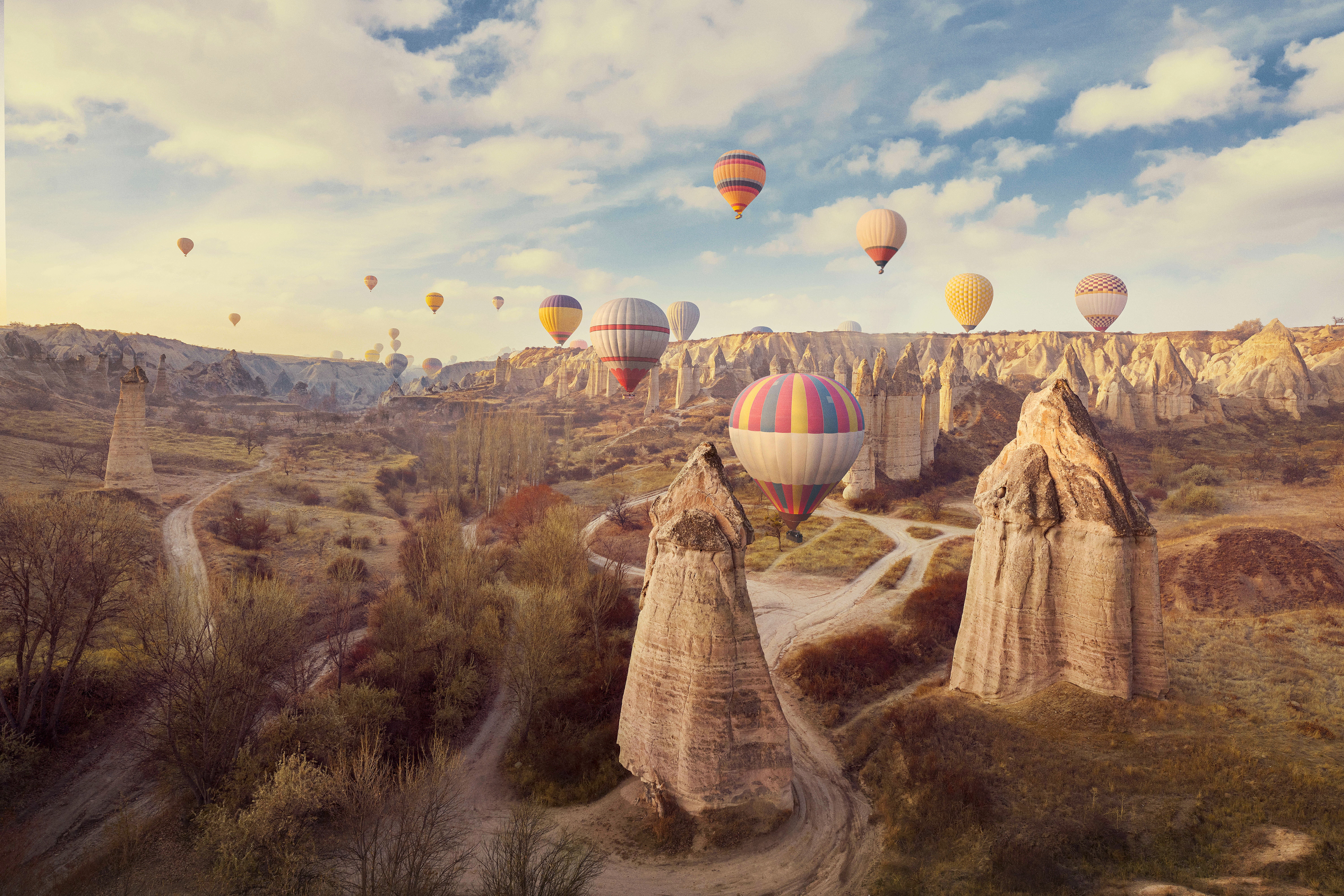
The fairy chimneys are the landscape feature most associated with Cappadocia. These tall, cone-shaped rock formations were created over millions of years through volcanic eruption and gradual erosion. They appear throughout the valleys around Goreme, Urgup, and Pasabag, and are best seen either on foot through the valleys or from the air on a hot air balloon at dawn.
The underground cities add a different dimension to the region entirely. Derinkuyu and Kaymakli are the two most visited. Derinkuyu descends eight levels below ground and is thought to have sheltered tens of thousands of people during periods of invasion. It includes living quarters, stables, storage rooms, a church, and ventilation shafts running the full depth of the structure. Both are open to visitors and located within an hour of Goreme.
The Journey from Istanbul to Cappadocia
Getting between the two regions is straightforward, and for most travellers, it is one of the easiest parts of the trip to plan.
Flights from Istanbul to Kayseri or Nevsehir take about 1 hour 20 minutes. From either airport, it is roughly a 45 minute to one hour drive to Goreme. Turkish Airlines and Pegasus Airlines both run multiple daily flights, so you have flexibility when it comes to timing. There is also the option of an overland bus, which takes around 10 to 12 hours. It is a slower route, but some travellers prefer it for the overnight journey and the change of pace. For most, though, flying makes the transition feel seamless. You move from the density and movement of Istanbul to the open, almost surreal landscape of Cappadocia within a matter of hours.
And that contrast is really the thread that ties this entire trip together. Istanbul gives you scale, history, and constant motion, while Cappadocia slows everything down, with its quieter streets, cave spaces, and long, unhurried evenings. Moving between the two does not just change the scenery, it changes the rhythm of how you experience the place.
By the time you leave, you realise you have experienced two entirely different worlds within a single trip.